Architects for Peace news and articles

25.6.19

CALL OUT FOR CAST MEMBERS: 'Clearance by Cappuccino' - a dialogue on affordable and diverse housing for everybody

(Above) role play and character development at our recent introductory workshop
Image credit: Free Theatre

'Clearance by Cappuccino' is a collaboration between Architects for Peace and Free Theatre using the mediums of dialogue and theatre to re-imagine the notion of affordable and diverse housing for everybody. We feel it is important to invite discussion into one space, bring the community together with architects, planners, urban designers, policy makers and more, to share perspectives on how housing affordability and housing stress involves and affects us all.

We are calling for people interested in taking part in a dialogue based performance as cast members. No prior acting experience is required. An interest in the topic is essential! We are looking for 5 - 6 cast members to form an ensemble.

Free Theatre will host a series of workshops and expose participants to the dialogue theatre methodology in the lead up to a public performance. Each cast member will have an opportunity to develop their character, and through this, develop a unique position on housing affordability.

Contact Nicole Mechkaroff at nicole@architectsforpeace.org for further details.

24.6.19

Alternative Housing Ideas Challenge - shortlist announced.

AHA! Alternative Homes Agency proposed by Architects for Peace

We’d like to congratulate the seven short-listed entries for the City of Sydney’s alternative housing ideas challenge, announced mid-June. These entrants will now have until November this year to develop their proposals further, and present them for public consultation.


The competition attracted over 230 entries, among them a proposal on behalf of Architects for Peace, developed by Megan Spoor, Eva Rodriguez Riestra, Nicole Mechkaroff and Eleanor Chapman.

Although globally many kinds of housing models exist, in Australia, reliance on a very limited range of housing tenure options not only keeps housing costs high, but also excludes other kinds of housing possibilities from the public imagination. Our proposal seeks to disrupt a deeply-rooted reliance on the private market by opening up the public imagination to other ways of living together – and practical means to realise them. 

We propose to establish an information agency to foster awareness of alternative housing models, as well as support development and implementation of self-organised housing initiatives. Our proposed Alternative Homes Agency (AHA!) challenges the dominant acceptance of the private housing market by filling a crucial gap in community knowledge and skills - a gap that prevents the imagining of alternatives. AHA! will work alongside government service providers and NGOs to:

  • Raise awareness among home-seekers of the diversity of possible communal housing models beyond private renting or ownership.
  • Map and create a register of existing vacant and under-utilised properties.
  • Educate home-seekers in the skills and knowledge needed to initiate a self-organised housing project.
  • Connect independent home-seekers from a range of backgrounds with Community Housing Providers, with a view to realising joint projects.


View our proposal in detail here

We’re grateful to the City of Sydney for leading a much-needed public discussion of housing alternatives, and for the internal discussion it’s sparked within our team recently! Architects for Peace is committed to standing up for decent affordable housing for all.

If you are interested in getting involved with related A4P activities, please contact us at team@architectsforpeace.org.

23.4.17

Address to City of Melbourne Submissions Committee - opposing local law changes that seek to punish the homelessness


Further to last month’s post on our submission to the City of Melbourne, outlining our opposition to the proposed amendments to the Activities (Public Amenity and Security) Local Law 2017 which we believe would adversely impact on people experiencing homelessness, two of our volunteers, Lara and Steve, represented Architects for Peace to address the Submissions Committee on 6 April.  More than 40 individuals and organisations chose to be heard in front of the committee, and each and every speaker rose to condemn the proposed amendments.  Many people with personal observations and experiences of homelessness expressed that council policy has already had a detrimental effect on their sense of belonging and self-esteem.  Many also expressed frustration with council’s procedure, which has bypassed and alienated established homelessness advisory bodies.

Committee resolutions included a call on management to commission a Human Rights Charter - Assessment of Compatibility into the proposed changes, along with a resolution to adjourn the meeting until 24 May to consider the volume of verbal and written submissions.  Further information, including an audio recording of the meeting, is available on the City of Melbourne website.


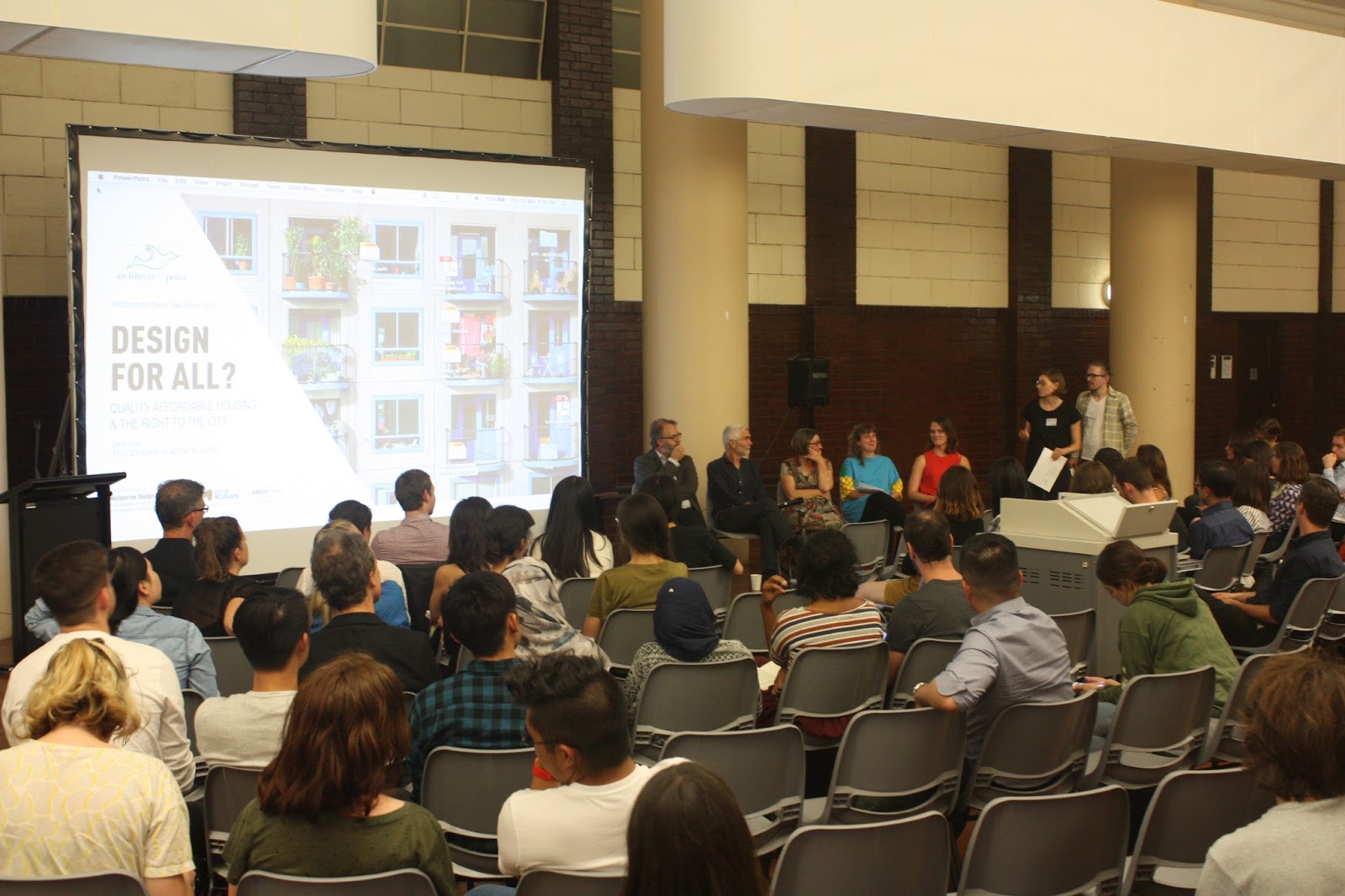
Design for all? Quality affordable housing and the right to the city


On 23 March 2017, Architects for Peace joined the Melbourne Design Week (MDW) conversation by hosting a discussion forum, Design for all?  Quality affordable housing and the right to the city, to explore the challenges and opportunities for delivering well-designed housing that enhanced the right to the city for all.  A panel of five speakers from design and non-design backgrounds presented their personal views, before taking questions from the audience.  The presentation and discussion all pointed to the fact that inequality and unaffordability of housing in Melbourne is on the rise, although the panellists were hopeful about future change and that a range of potential solutions were identified.  Whilst many ideas discussed were design focused, and it can be agreed that design does play an important role in ensuring affordable and accessible housing in our cities, the panellists recognised that a 'whole systems approach' is the best way forward.


This event is sponsored by the City of Melbourne and ArchiTeam


22.3.17

Defending the right to public space: Architects for Peace opposes local law changes that seek to punish homelessness

In response to the City of Melbourne’s proposed amendments to the Activities (Public Amenity and Security) Local Law 2017, we made a submission, outlining our opposition to the changes. Not only would the proposed changes deny people experiencing homelessness their rightful access to public places, it would also allow for the confiscation and impoundment (a $338 fine!) of their belongings. We view these changes as effectively criminalising homelessness and in violation of human rights, in particular, the right to be protected from cruel, inhuman or degrading treatment. We’re not alone in our opposition: the United Nations Special Rapporteur on the Right to Adequate Housing, Leilani Farha, has also condemned the amendments. You can read our submission here.

Representatives from Architects for Peace will present our viewpoint to a City Council Committee on Thursday 30 March 2017 in the Melbourne Town Hall. We’ll keep you posted on the results. #nohomelessban.

Image credit: EvoLens

16.10.16

October Talk @ Building 50, RMIT

Architects for peace went around the streets of Melbourne to gather thoughts on homelessness in our city.
Here is a teaser for the full length video to be shown this Friday"
Join the discussion this Friday 7th of October @ Building 50, RMIT - 7pm.
Event details: bit.ly/arch4peaceoctalk


17.5.15

Event series - Our Homes, All Right? (Volume 1) movie night,Thursday 21 May 2015.

Dear friends,


Since completing our Strategic Plan last year, we have been focused on working towards our fourth goal: 'stand up for quality affordable housing and the right to shelter'.

In collaboration with Friends of Public Housing Victoria, Architects for Peace invites you to a film night: Our Homes, All Right? (Volume 1) to discuss the issue of transfers in public housing to non-government housing providers and its effect on public housing tenants. We hope you can join us!


Date: Thursday 21 May 2015
Time: 7 - 10pm
Venue: North Carlton Railway Neighbourhood House
             20 Solly Avenue, Princes Hill VIC


Guest speaker Fiona Ross, spokesperson of Friends of Public Housing Victoria will present a talk on the effects of public housing transfers in Victoria. This will be followed by a screening of the film Rent Rebels / Mietrebellen (Germany) to look at gentrification and forced evictions in Berlin with public housing tenants fighting to stop the displacement of their community.


Light refreshments provided.
Gold coin donations are appreciated.


Check out our Facebook event here.
Entry is free, no RSVP required.


Event sponsor: ArchiTeam


We are looking forward to seeing you there!

28.2.15

La revancha de los cités: dos planes revivirán a estas históricas viviendas

This article was first published by El Definido on 24.02.2015 and republished here with the permission of its author Magdalena Araus, Chile.

Imagen: © Iván Theoduloz / Arquibus

Restauraciones, renovación y nuevas construcciones que los imitan son las maneras de revivir a los cités en Santiago. Estas primeras viviendas sociales cada vez son más valoradas, tienen muchos beneficios que ofrecer y no están dispuestas a morir.

12.6.13

La belleza como instrumento de identidad, complejidad y resilencia

Luciano Kulczewski García (Chile, 1896-1972) y la importancia de crear ambientes sustentables, en el ámbito social, económico y medio ambiental.


Vivienda social: one of many examples of social housing in Barrio Madrid, Santiago, Chile. Fuente propia.

24.11.12

Architectural design studio: designing for a purpose

Writes: Beatriz C. Maturana

The following article features a design studio (taller) at the University of Chile, Faculty of Architecture and Urbanism, led by Orlando Sepulveda (7th semester architecture students). 

The studio focuses on a significant and poorer district in Santiago, so significant in fact that one of its landmarks, Zanjón de la Aguada—a canal formally known for its industrial and organic waste pollution—had the unfortunate capacity to conjure inhospitable images of misery, crime and industrial decay, images that have negatively shaped the perception of that part of the city. Fortunately but slowly, these perceptions are fading away as something of the past. Most recently, the news that the Metro (Santiago´s underground) will open a station in heart of this district and the completion of the Parque La Aguada, part of the Bicentenary Projects (an extensive new flooding park running along the Zanjón de la Aguada canal), may put a definitive end to the stigma attached to the area and hopefully will positively impact on the entire city. A question arises as to how the improvements brought by these large urban interventions can be sustainable over time and ensure the best possible results for the district and for the enjoyment of the existing population.

Figure 1: proposal by María de la Luz Lobos, Mathilde Marcantoni and Gabriel Arias. 

1.10.12

Haiti´s first Ministry of Housing

The following summary is based on an article of El Mercurio, Manuel Valencia (29.09.2012) entitled “El constructor chileno de Haiti” (The Chilean builder of Haiti). Brief and translation by Beatriz Maturana.

Photo: El Mercurio, Guillermo Rolando

As director of the Fundación América Solidaria (Solidarity America Foundation) and having spent two years in Haiti, Guillermo Rolando assisted a military contingent sent from Chile to Haiti to provide humanitarian aid during the stabilization period that followed the 2004 military coup against President Bertrand Aristide.

Most recently, while serving as Director of the Division of Housing Policy of the Ministry of Housing (MINVU, Chile) and moved by the devastation left after the Haiti earthquake (2010) that flattened the capital and killed about 300,000 people, Guillermo accepted the responsibility for the creation of the first Ministry of Housing in Haiti. Six months later, this newly formed Housing Ministry of Haiti, modelled around the Chilean Ministry of Housing, is approaching its first program for housing subsidies and plan for permanent residencies for those affected by the earthquake. This is certainly not a small task for Guillermo Rolando in America´s poorest country and one of the poorest countries in the world.

14.4.12

SOCIAL DISTINCTION AND RESIDENTIAL HABITAT IN LATIN AMERICA

Author: Sonia Roitman
Source: Revista INVI

Abstract


The increase of urban insecurity and the fear of crime have triggered the development of gated communities in Latin American cities. This residential model has even attempted to extend its target not only to upper-middle and high socioeconomic groups, but also to lowermiddle and low income groups. However, this paper shows how living in gated communities is still related to social distinction and status. This article analyses the main characteristics of gated communities, who their residents are, their daily activities and interests as well as their relation with the city. It is concluded that gated communities are an important element of social distinction and belonging for some
social groups.

KEYWORDS: GATED COMMUNITIES, SOCIAL DISTINCTION AND RESIDENTIAL HABITAT.

Find this article: Revista INVI

19.10.11

Implementing the right to the city in Brazil

The right to the city is a concept employed by a variety of actors at different scales, with its use ranging from being nestled within the status quo to staunchly anti-capitalist. Although present in many declarations and charters, the one place where binding legislation on the right to the city actually exists – along with inevitable, significant tensions inherent in its implementation – is Brazil.

Comunidade Campo Grande Jurubatuba, an informal settlement in Santo Amaro subprefecture, São Paulo. Magic Condominium Resort tower in the background.

Thanks to decades of struggle by an alliance of social housing movements, professionals, squatters, NGOs and academics, legislation ensuring the right to the city has been enshrined in the 2001 City Statute, a development law regulating the chapter on urban policy, specifically articles 182 and 183, in Brazil’s 1988 Constitution.

Cohousing – an instrument for peaceful resolution of conflict

Cohousing, i.e. housing with communal spaces and shared facilities, is gaining momentum in Europe, USA, Australia and some other countries. The author of this article has been involved in research on cohousing since the middle of the 1960s and lives in one such housing unit in Stockholm since 1996. In this article the focus is put on the possible contribution of cohousing to peaceful resolution of conflict.


The cohousing models of today were influenced by examples far back in history. In her books about the history of communitarian settlements in the USA the famous feminist architect researcher Dolores Hayden finds that these projects were based on wishes to establish self-sufficient settlements incorporating both industry and agriculture. The design solutions were determined by the machine ideal (forerunners of modernism), the model home idea (emphasising new lifestyles) and/or the garden ideal (forerunners of ecovillages 100 years later).
In the cohousing unit Tullstugan in Stockholm (home of the author) 50 residents share the duty of preparing dinners four evenings a week. Each member is served meals 18 out of 20 times without any duties of shopping, cooking or dish washing. Twice every fifth week one has to spend four hours cooking for other residents. Men and women have equal duties.

25.7.11

Volunteer travel, is it for our own benefit or do we actually contribute ?

Volunteer travel, one of the most growing sectors in the tourism industry. As a student, honestly I was debating for a long time on whether it’s worth to put my hard earned saving into doing it. Gathering friends over for discussion, two comments stick­ into my mind: is it altruism or the expected post-volunteer fell-good-feeling that motivate people doing volunteer travel? Do we really make a difference over such a short period of time? At that time it was hard to argue because none of us had done it before. Hence, after much dilemma, I decided to go for it and try to find the answers to those questions.

8.6.11

Do you want size with that? The McMansion malaise

This article was originally published in The Conversation on 7 June, 2011. The article has been re-published under under Creative Commons license.

Author: Terry Burke. Professor, Institute for Social Research at Swinburne University of Technology

Living large down under – Australians love big houses. travelskerrick/flickr

Australia has long prided itself on being an equal society, and for most of the 20th century our housing was a mirror of that value or belief.

Almost all houses were single-storey detached and, with the exception of the Tooraks and Vaucluses, the dwellings of the affluent were not greatly larger than those of people on more moderate incomes.

1.12.10

Housing behind bars


25% of all prisoners on the planet are incarcerated in the United States of America, according to an article published in the Boston Globe recently. That's 2,500,000 people - creating the third biggest industry in that country. It hasn't always been like that, in the Seventies incarceration rates were similar to other countries. The Globe draws a comparison to the parallel reduction in the provision of new public housing in the U.S. Borrowing from the research of sociologist Loic Wacquant, the article says,

In the 1990s, as federal corrections budgets increased by $19 billion, money for housing was cut by $17 billion, “effectively making the construction of prisons the nation’s main housing program for the poor."
In the current recessionary atmosphere public spending is decreasing - so what does this mean for these "big houses"?

Read on at James Carroll's Boston Globe article.

26.9.10

Urban Growth Boundary - Public forum - recap

We called a forum to debate the recent State government decision to expand Melbourne's Urban Growth Boundary. A crack team of experts was lined up to participate in a discussion on this announcement – the aim being to flesh out the context of the decision, the implications for Melbourne and outer-suburban communities (existing and future) and alternatives to urban sprawl.


Give the people what they want! (bananas?)

Tony de Domenico (Urban Development Institute of Australia) and Stuart Worn (Planning Institute of Australia) shared the pro-expansion corner; de Domenico claiming that developers are driven by creating affordable housing and 'what people want', a position that Worn carried further by valiantly expounding the inalienable right to live near work, friends and family (although failing to articulate just how this is achieved by making sheep paddocks available for suburban living). To be fair, it soon emerged that credit was due to both Worn and de Domenico for voicing what proved to be a minority view on a panel (and in front of an audience) that was otherwise roundly dismayed at the planned expansion and concerned about its consequences for Melbourne's sustainability.

Both seemed to plead a kind of helplessness of their respective bodies in the face of two intrinsic forces - the market (de Domenico compared houses to bananas in a reference to Cyclone Larry's impact on the Queensland banana crop in 2006) and the will of the people – essentially dictating where and what kind of housing is made available. This seemed to be something of a flimsy premise (is it always a choice to live in the outer suburbs, or might it be in some cases an inability to afford anywhere else?) and as Dianne Moy made an argument for the oppositecase – noting that the structure of the market can effectively prevent alternatives from emerging, and changes in the system are needed to present people with real choices of alternative forms of housing.

Housing affordability

The argument that expanding the UGB would improve housing affordability was dismissed as a fallacy by Kate Shaw, who suggested that the measure is in reality driven by the government's interest in economic growth through creating opportunities for developers, and Dr Carolyn Whitzman, who noted the financial disadvantage experienced by poorer outer suburban dwellers without access to infrastructure and forced into car-dependency.

Infrastructure

While Dr Paul Mees was adamant that an effective public transport system is achievable no matter what the size of the city, there was general consensus that the current trend to create houses ahead of transport infrastructure is concerning, contrary to the historical growth of Melbourne and unsustainable.

Planning consultation

2030 inevitably reared its ugly head, and was criticised for its authors having failed to engage with communities during its development. As the discussion turned to politics, the need for a genuinely democratic planning process was raised, with a comment from the floor suggesting that lack of public consultation breeds a general sense of frustration and disempowerment among communities, who resort to lodging objections (sometimes leading to VCAT legal battles) in order to engage with the planning process. It was a sentiment that was evident in comments from representatives of residents' groups in the audience, clearly passionate about appropriate development, but frustrated by a consistent lack of governmental response to their concerns.

So, where to next?

Some of the key points to emerge from the discussion...


  • Planning reform needed (there are helpful overseas precedents)
  • Different forms of tenure could be made available to people – ie not just home ownership – co-housing/ownership as a possible alternative?
  • Strategies to address disempowerment and engage people in planning processes – not just as objectors to decisions
  • Need to lobby government
  • What role can design play? How can architects work more directly with people on small-scale incremental changes to their dwellings?

A number of questions remain. We want to continue this conversation and would welcome your contribution (please feel free to comment below). A video recording of the night will be up on the words page soon. Note that submissions to the Growth Areas Authority are currently invited - see http://www.gaa.vic.gov.au/index/ for more info.

Thank you to the panellists for generously providing their time and insights, and a special thank you to Ian Woodcock for his input in the lead up to the forum, and for chairing a discussion that managed to be equally informative and entertaining!

21.6.10

‘If you want to fuck with the falcons, you’d better learn how to fly’

By: Rory Hyde

This article was first published on Archis' Action! Blog

A brief roundup of ‘extra/ordinary’, the Australian Institute of Architects national conference, Sydney, April 2010

Although delivered simply as an amusing anecdote, when taken out of context, this crude piece of wisdom from the elder statesman Peter Corrigan seemed to capture the essence of ‘extra/ordinary’. This was a conference about engaged practitioners; engaged in the ‘ordinary’ messy reality while still managing to scratch out something ‘extra’. Architects presented innovative (and often idealistic) approaches to complex problems, while not afraid to go beyond the discipline to engage with the pragmatics of financing, policy or public engagement in order to see them executed.

Creative director Mel Dodd’s vision for the conference included the words ‘contingency’, ‘compromise’, ‘complexity’, ‘concession’, ‘collaboration’ and ‘constraint’ – a clear endorsement for tentative conclusions and grappling with the real as opposed to the confident presentations of crisp and complete buildings by architectural stars as we have seen at past conferences. This is at once a reflection of our ‘no frills’ economic times – an end to the age of excess – but also a statement of urgency for the profession. If we continue to hitch our future on offering rarefied aesthetics instead of participation in the complex mechanisms of the city, our days are surely numbered.

30.4.10

Rebuilding in Aceh

Foreign Correspondent on ABC1 Australia next week will show a documentary that includes an investigation into reconstruction efforts at Aceh after the Boxing Day Tsunami in 2004...

The show will be on Tuesday May 4th at 8.00pm.

Indonesia Correspondent Matt Brown has discovered that rebuilding effort has been chaotic and in places very uneven. He meets former merchant banker turned hands-on helper Sarah Henderson who learned quickly not to make the same mistakes as some aid agencies that had constructed homes for non-existent villagers.

“When I was designing the houses I though oh how great I’ll give them an inside bathroom, I’ll give them an inside kitchen oh this is going to be wonderful and when they saw the plan they were horrified and they said no, no, no, no they didn’t want the bathroom inside, they didn’t want the kitchen inside and so I think listening is very, very important.”
SARAH HENDERSON


LINK