Architects for Peace news and articles

21.10.20

La ciudad: ¿escenario de convivencia ciudadana o moneda de cambio para la extorsión?

Architects for Peace's president, Beatriz Maturana recently published an article from the city of Santiago. The letter appears in El Libero and in El Mercurio (22.10.2020) and deals with the role of the professions of the built environment in the social unrest. Political parties and institutions from the left and center-left supported the uprising of 18th of October 2019, the Estallido Social. The center-left had governed for 24 of the last 30 years and lost office to the second center-right government in 2018. The Estallido Social is distinguished by its unprecedented level of violence and destruction of urban infrastructure, architecture and built heritage. This protest forced an agreement for a plebiscite to approve or reject a new constitution together with an agreement for peace. The Plebiscite is next week but peace never came. A year later, the violence that looted, burnt and destroyed the entire Metropolitan transport system, medical centres, schools, universities, hotels, businesses, supermarkets and churches had spread across the country. In the rural south, homes continue to be burnt. Marking one-year, protesters destroyed with arson attacks two historic churches in central Santiago. They had both been partially destroyed when the crisis began in October 2019. The crowd of young protesters applauded and screamed as the burning church spire fell.

Beatriz has lived and worked in many parts of the world but has not witnessed a citizenry destroying its own built heritage or seen young people being manipulated by falsehoods. Chile has the highest Human Development Index in Central and South America.

Architects for Peace was formed because cities are where over half the world’s population lives and are the target of contemporary wars and civil conflict. In Chile, there is no professional body that represents the professions of the built environment which is speaking against the violent destruction of Chilean Cities, of its capital, Santiago.  
 
Image source unknown, mostly from local media.


La ciudad: ¿escenario de convivencia ciudadana o moneda de cambio para la extorsión?

Publicado en El Libero, 20 de octubre, 2020
Publicado en El Mercurio, 22 de octubre, 2020

Señor Director:

La destrucción sin precedente iniciada el 18 de octubre del año pasado hizo retroceder al país en 40 años. Los costos calculados hasta febrero de este año indicaban que éstos superaban lo invertido en un año por concepto de gratuidad en educación superior, y que la reparación de las 118 estaciones del Metro excedió el gasto anual del sistema de subsidio habitacional. Lo anterior no considera el daño infringido a la sociedad y a la credibilidad del país.

22.5.20

How Might the COVID-19 Change Architecture and Urban Design?

The following interview by Michel J. Crosbie of Prof. Ashraf Salama has been republished with the authorization of those involved and Common Edge Collaboration's director Martin Pedersen.
Prof. Ashraf Salama is a long-time contributor to Architects for Peace and its editorial committee.


In the wake of the global pandemic crisis, there’s been speculation about how architecture, urban planning, and design might be permanently affected. Ashraf M. Salama, a professor at the Department of Architecture, University of Strathclyde, in Glasgow, Scotland, and the director of the university’s Cluster for Research in Architecture and Urbanism of Cities in the Global South, has been following how these disciplines might be changing. He’s recently written a publicly peer-reviewed paper on some of his findings: “Coronavirus Questions That Will Not Go Away: Interrogating Urban and Socio-Spatial Implications of COVID-19 Measures.” I sat down with Salama to discuss some of the issues he raises, and what their implications might be for the built environment in the future.

8.11.19

Cities and the Ethical Turn: Cities and Climate Change

Published by CitiesProgramme on 

Pictured: The Metro Station University of Chile, the most extensive Metro Network in South America, powered by 60% renewable energy. Sadly 80 stations have been destroyed in the recent protests. About Santiago’s Metro.
Author: Beatriz Maturana

The words ethics and cities have recently been combined by philosophers and urbanists to focus on a turn towards sustainability in the urban century. Climate Change charges this turn with an alarming urgency. While we know that there is no single solution to meet this challenge, today it is recognized that cities have the capacity, resources and ability to find solutions within the UN Sustainable Development Goals.  As stated by the C40 organization, “the outcome of climate change begins in the cities”.
In Chile, our National Urban Development Policy, Sustainable Cities and Quality of Life (NUDP 2014), lays the foundations and guidelines for the improvement of our cities in not only in their physical but also cultural aspects and in pursuit of sustainable objectives. In this way, we want to highlight the significant role of cities and their ability to improve the conditions of the planet and the lives of its inhabitants. This policy is based in the “conviction that our cities and populated centres could be much better than they are if, as Chileans, we agree on some fundamental aspects that govern its formation and development”.

Why Cities?

The NUDP places the urban issue as a “national theme” and a key pillar for our development. The policy objectives of quality of life and sustainability force us to urgently face the challenges of climate change.
  • 70% of cities are already suffering the effects of climate change and 90% of all urban settlements that are located on the coastal edges. It will be these settlements and among them the poorest, that are first affected by the rise in the level of the oceans.
  • Of the 9 criteria of vulnerability to climate change, Chile and its cities meet 7 of these: Low-lying coastal areas; Arid zones and Forest zones; Territory susceptible to natural disasters; Urban areas with air pollution; Areas prone to drought and desertification; Mountainous Ecosystems. [1]
  • Changes that affect the water supply will impact more than 50% of the world’s population living in cities today. [2]
  • In the case of Chile, 87% of its population lives in cities, and its capital city faces the effects of desertification.

How can cities, which are considered as a source of the problem, be re-thought as the source of a solution to climate change?

To discuss these issues and to better prepare us to face the challenges imposed by climate change, we will hold a day of forums, talks and interdisciplinary round tables. We will discuss the key aspects that, in line with our urban policies, highlight the urgency and allow a refocus and reassessment of the guidelines to strengthen our commitment to sustainable cities and quality of life. A report will be produced at the conclusion of the seminar.
In the wake of the October demonstrations Chile’s world standing as host for COP25 has shifted from its credentials of achieving carbon neutrality by 2040 to be the epicentre of the people’s movement for social justice. In the process, our cities and our urban conviviality have been severely wounded by vandalism at an infrastructural scale and civil disorder in widespread looting and arson. In this democratic republic, the institution of government is steering solutions to long due social justice issues that had not been met by governments of various tendencies for the last three decades of economic growth. With COP25 at our doorstep, the attention must draw together the social, the urban and the challenge of climate change.
The seminar ‘Cities and the Ethical Turn: Cities and Climate Change’ endorsed by COP25 will run on December 10.
Dr. Beatriz Maturana is a Cities Programme Global Advisor, an Adjunct Professor of the School of Global, Urban and Social Studies at RMIT University, Associate Professor at the Institute of History and Heritage, Faculty of Architecture and Urbanism (FAU), University of Chile and the founder of Architects for Peace. Her teaching is in the areas of sustainable urban development & heritage, and interventions in public space and undertaking research on urban social integration. Beatriz graduated in Architecture at RMIT University, later undertook a Master of Urban Design and a PhD from the University of Melbourne. In Australia she practised as an architect, urban designer, and taught at RMIT, Monash and University of Melbourne.

[1] Ministerio del Medio Ambiente. (2019). Simulaciones Climáticas.
[2] Plan de Adaptación al cambio climático para ciudades 2018-2022, 6/2018 (MMA, MINVU 2018).

Original Publication in UN's Global Compact Cities Programme: https://citiesprogramme.org/cities-and-the-ethical-turn-cities-and-climate-change/#_ftn1

Note: this text was written before the Chilean Government had to decide to move COP25 to Madrid, given the situation in the country, and before the team preparing the University´s conference decided to postpone the event for the same reasons. 

11.12.16

El pillaje del patrimonio cultural Palestino

By Sergio Yahni  
(This article was first published in Sergio Yahni's blog in October 31, 2016 and has been republished with the permission of its author. Find an English version of this article here.)

Maqueta del edificio del “Campus Nacional de Arqueología” que albergara las oficinas de la Autoridad de Antigüedades, almacenes que darán cabida a dos millones de artículos, laboratorios, una biblioteca y un magnífico espacios de exposición (fotografía: Israel Archeological Authority).
"The construction of Israel’s National Archaeology Campus (NAC), designed by architects Moshe Safdie and Irit Kohavi, has slowly but steadily progressed since 2012. NAC will sit next to the Israel Museum and Bible Lands Museum in central West Jerusalem, on what Israelis call “Museum Hill.” The $104 million building spans 35,000 square meters and stands nine floors tall. Inside will be the offices of Israel Antiquities Authorities, storage for two million artifacts, laboratories, a library, as well as exhibition spaces." Find an English version of this article here.

La construcción de un nuevo “Campus Nacional de Arqueología” diseñado por los arquitectos Irit Kohavi y Moshe Safdie todavía esta en curso y continuará por al menos otros 14 meses. La idea de construir este campus, que se encuentra en las cercanías del Museo de Israel y el Museo de la Biblia, surgió tras los Acuerdos de Oslo con el objetivo de transferir las colecciones del Museo Rockefeller de arqueología, situado en Jerusalén Oriental.

Se trata de un proyecto que no ha tenido un impacto internacional pero que claramente contradice convenios internacionales que tienen como objetivo prevenir el saqueo de la riqueza cultural de una región ocupada militarmente.

El museo Rockefeller de arqueología fue establecido durante el Mandato Británico de Palestina Contiene una gran colección de piezas arqueológicas desenterradas en las excavaciones llevadas a cabo entre los años 1920 y 1967.

Este museo se estableció como parte de una política británica de exponer en sus países de origen hallazgos arqueológicos que se consideraban parte del patrimonio nacional. Anteriormente esto hallazgos hubieran sido “exportados” a la metrópolis.

Esta idea ya se había llevado a la práctica en otras colonias del Imperio Británico donde se abrían centros dedicados a la actividad arqueológica que incluían oficinas para el Departamento de Antigüedades, salas de almacenamiento y un museo para exponer las piezas.

Interior del Museo Rockefeller en Jerusalén Oriental. El edificio
construido por por Austen Harrison fue iniciativa del Mandato Británico
de Palestina con el objetivo de crear un patrimonio nacional arqueológico
del país (fotografía: Wikipedia).
El museo adquirió su nombre cuando en 1925 John D. Rockefeller Jr. accedió a donar dos millones de dólares para el proyecto a pedido de James Henry Breasted, fundador y director del Instituto Oriental de la Universidad de Chicago.

Tras los acuerdos de cese de fuego jordano-israelíes de 1949 el museo Rockefeller paso a poder del Reino de Jordania. 39 años mas tarde, en Julio del 1988, cuando el gobierno jordano rescindió de sus demandas territoriales en Cisjordania este tendría que convertirse en parte del patrimonio cultural del Estado Palestino y por lo tanto estaría protegido por convenios internacionales de los cuales Israel es parte.

Como parte de un territorio ocupado esta riqueza cultural debería estar protegida por los Convenios de Ginebra, la Convención de La Haya para la Protección de los Bienes Culturales en caso de Conflicto Armado, por Convención sobre las Medidas que Deben Adoptarse para Prohibir e Impedir la Importación, la Exportación y la Transferencia de Propiedad Ilícitas de Bienes Culturales y otros convenios internacionales que tienen como objetive evitar el pillaje de bienes culturales durante conflictos armados o en situaciones de ocupación militar.

Pero tras la ocupación de la ciudad en 1967 y su anexión en 1980 Israel ignoro estas múltiples protecciones transfiriendo la administración del museo y sus colecciones a la Autoridad de Antigüedades de Israel transformándolo en una institución israelí mas.

La construcción del “Campus Nacional de Arqueología” Israel forma parte de un proceso de vaciamiento de los valores culturales de Jerusalén oriental que desde la ocupación fueron confiscados, clausurados, o que simplemente se dejaron decaer en desuso.

El nuevo predio en construcción sera un edificio de 35 mil metros cuadrados que se extenderá en nueve plantas y costada 400 Millones de dólares norteamericanos. Este edificio albergara las oficinas de la Autoridad de Antigüedades, almacenes que darán cabida a dos millones de artículos, laboratorios, una biblioteca y un magnífico espacios de exposición.

Hava Katz, doctora en arqueología y conservadora jefe de las exposiciones, ha dicho al periódico Haaretz que el cielo raso de la plaza de entrada tendrá un número de mosaicos bizantinos “que estaban en edificios o espacios públicos y parte de ellos serán expuestos por primera vez”. Uno de estos los mosaicos, que se encontraba en las bodegas del Museo Rockefeller cubría el cielo raso de en una capilla bizantina Beit She’an que fue excavada durante el Mandato Británico por el arqueólogo Michael Avi-Yonah. Katz cuenta que este mosaico trae imágenes de la vendimia, de animales de pastoreo y de caza. Dentro del edificio habrá un espacio de exposiciones con techo transparente.

Sin duda el nuevo “Campus Nacional de Arqueología” es un proyecto ambicioso pero no es seguro que pueda competir con una joya arquitectónica tal como es el edificio del Museo Rockfeller, que fue diseñado por Austen Harrison. Por otro lado, este proyecto, que no fue detectado por el radar de la UNESCO representa un peligro mas a las riquezas culturales palestinas y confirma la “necesidad urgente de llevar a cabo la misión de monitoreo reactivo” por parte de la institución internacional.

30.11.15

Brazilian mine disaster: another tragic example of the failure of businesses

At the centre of this catastrophe is the urgent need for governments to have the wellbeing of their people at the forefront of their agenda. As stated by the Special Rapporteurs “this disaster serves as yet another tragic example of the failure of businesses to adequately conduct human rights due diligence to prevent human rights abuses.”

Source: United Nations - Human Rights

Portuguese version

GENEVA (25 November 2015) – Two United Nations independent experts on environment and toxic waste today called on the Government of Brazil and relevant businesses to take immediate action to protect the environment and health of communities at risk of exposure to toxic chemicals in the wake of the catastrophic collapse of a tailing dam on 5 November 2015.

“This is not the time for defensive posturing,” said the UN Special Rapporteur on human rights and the environment, John Knox, and the Special Rapporteur human rights and hazardous substances and wastes, Baskut Tuncak. “It is not acceptable that it has taken three weeks for information about the toxic risks of the mining disaster to surface.”

“The steps taken by the Brazilian government, Vale and BHP Billiton to prevent harm were clearly insufficient. The Government and companies should be doing everything within their power to prevent further harm, including exposure to heavy metals and other toxic chemicals,” they stressed.

New evidence shows the collapse of a tailing dam belonging to a joint venture of Vale and BHP Billiton (Samarco Mining S.A.), which released 50 million tons of iron ore waste, contained high levels of toxic heavy metals and other toxic chemicals in the river Doce. Hospitals in Mariana and Belo Horizonte, the capital city of Minas Gerais State have received several patients.

“The scale of the environmental damage is the equivalent of 20,000 Olympic swimming pools of toxic mud waste contaminating the soil, rivers and water system of an area covering over 850 kilometers,” Mr. Knox warned.

- See more at: http://www.ohchr.org/EN/NewsEvents/Pages/DisplayNews.aspx?NewsID=16803&LangID=E#sthash.h9HynK7j.dpuf

15.6.15

Valparaíso, puerto y montaña: un desafío [en] pendiente.

Image source: Verónica Maturana, Valparaiso 2014. 
SOURCE: Revista AUS
WRITES: Beatriz Maturana

ABSTRACT/ "The following reflections are part of a seminar presented during the Sustainability Week (May, 2014), in the University of Chile. The seminar addressed the recent fire in Valparaíso, comparing it with the fire that affected part of the state of Victoria, Australia (February 7, 2009). Both fires are considered to be the most devastating events in the history of each country. The seminar worked with four questions, which helped guide the presentation and questioned certain premises. One of these premises was the notion that an urban scale issue can be solved at the housing level, which is a distorted use of the idea of sustainability. Comparing both cases, a notable issue is that both put an emphasis on housing solutions to address a much more critical problem, which was and still is a lack of planning."

12.5.14

Appeal for Valparaiso

Image source: http://www.ctvnews.ca/world/chile-s-historic-port-city-of-valparaiso-goes-up-in-flames-1.1773800

The following is a letter sent to our colleagues at ARC-Peace and we have taken the licence to republish it in order to support the appeal.

Dear ARC PEACE colleagues,

I imagine that you are in knowledge of the mega fire that recently affected the city of Valparaíso (Chile), 12-13 of April. In that context the School of Architecture of the Valparaíso University in conjunction with the Department of Architecture of Santa Maria University, decided to head a solidarity rally under the motto "20,000 metal sheets for Valparaíso" consisting in gathering same number of Zinc alum roof sheets to be distributed among 1,000 affected families.

Please note with how little we all can help the thousands of homeless victims! All donors should follow the particulars of the Valparaíso University bank account to send their contributions. Finally, I shall be most grateful if you would kindly pass the word among your contacts.

Thank you on behalf of many homeless that right now face a hard winter time!

Lautaro Ojeda Ledesma, architect (University of Valparaiso)
Doctorate in Land Use and Urbanism (Université de Bretagne Occidentale, France)
UNESCO External Surveyor for "Creative City Network"
Adjunct Professor with the School of Architecture, University of Valparaiso
Editor of Márgenes Magazine, University of Valparaiso
Associated Researcher (Institut de Géoarchitecture, France)


Donations for Valparaíso victims in Chile
From 16/04/2014 till 30/05/2014 you may donate via internet through an electronic transfer to:

Beneficiary: Universidad de Valparaiso
Current Account Nº: 5100117705
Bank: Santander Chile
Swift Code: BSCHCLRM

Intermediary Bank: Banco Santander, Madrid, Spain
IBAN: ES4200495494852910148818

Note: 1 metal sheet = 10,00 euros (U$S 12,00)

14.9.13

Freirina Rebelde: "Territorios desamparados frente a la búsqueda del desarrollo económico”.

En el marco del curso de formación general “Conflictividad Socio-Ambiental y el Resurgimiento de lo Local: el Medio-ambiente en Disputa” a cargo del taller SOMA (Sociedad y Medio-ambiente), realizado entre abril y julio del 2013 en la Universidad de Chile, las alumnas de quinto año de Arquitectura Scarlet Campos y Apolet Oteiza  desarrollaron la investigación “Freirina Rebelde: "Territorios desamparados frente a la búsqueda del desarrollo económico”.

Durante el transcurso de este año, los diarios han publicado los reclamos de la población de Freirina, localidad ubicada en el valle del Huasco en la III región de Atacama, Chile, dejando en evidencia la problemática social y medioambiental que estaría generando Agrosuper en el territorio, lo que nos lleva a cuestionar ¿Cuál es el rol que cumplen las megas industrias alimentarias como Agrosuper? ¿Qué ocurre en el territorio donde se localizan? ¿Por qué su funcionamiento solo puede ser justificado desde una lógica capitalista?

Comunas del valle del Huasco y ubicación de plantas Agrosuper. Fuente: elaboración propia basada en ubicación entregada por el Servicio de Evaluación Ambiental.

8.7.12

End of an Era

End of an EraSo now what do we do to defend life on Earth?

By George Monbiot, published in the Guardian 25th June 2012

It is, perhaps, the greatest failure of collective leadership since the first world war. The Earth’s living systems are collapsing, and the leaders of some of the most powerful nations – the US, the UK, Germany, Russia – could not even be bothered to turn up and discuss it. Those who did attend the Earth summit last week solemnly agreed to keep stoking the destructive fires: sixteen times in their text they pledged to pursue “sustained growth”, the primary cause of the biosphere’s losses(1).

The efforts of governments are concentrated not on defending the living Earth from destruction, but on defending the machine that is destroying it. Whenever consumer capitalism becomes snarled up by its own contradictions, governments scramble to mend the machine, to ensure – though it consumes the conditions that sustain our lives – that it runs faster than ever before.

3.7.12

RIO+20: Thoughts from an outsider

Rio+20
Thoughts from an outsider

Conversations you have in the hot pools at Ngawha Springs, in the north of New Zealand, have an air of unreality about them. Precisely because they are real. People say what they think without any attempt at manipulating or massaging the message. These conversations can be as informative as they are startling. You look at life right in the eye, and then are left to ponder what to do about it.

I asked one individual what he had been up to during the day. “Shooting ducks.” “You like eating ducks then?” “No, it’s the killing I enjoy.” I must have looked startled, even through the steam. He wanted to set my mind at ease. “I’m into conservation too.” he went on. “One of my mates has set aside 500 acres where the pheasants are protected so they can breed.” He thought wistfully, and then added “When they open it up the shooting will be fantastic.”

Banner: “The waste-pickers and recyclers of the world are doing more for 
the environment than all of Rio+20.” Photo: Colin Miller
Rio+20 was a world in denial, confused by all the smoke and mirrors of green economics, and completely lacking the honesty you find at Ngawha Springs. At UNCED in 1992 we were eyeballing life and getting on with it. Those of us involved in ending the Cold War believed that anything was possible, and sorting out the environmental mess was just a process of getting on with the job. Tough, but possible. We knew you had to be focused and to see clearly.

Rio+20 seemed to be only pretending to be concerned about the environment. Rather like those academic conferences where participants are focused on advancing their careers rather than changing the world. Before UNCED 1992 we had done our homework, and afterwards we followed through on what had been achieved. In Rio we convinced Susan Maxman to bring the issues forward to the UIA/AIA Congress the following year, and New Zealand played a leading role in that Congress. Back home the 1993 Papatuanuku Conference polarised the architectural profession. The seeds for Enviroschools were planted. All over the world Agenda 21 offices were opened up as local governments everywhere tackled the issues we had raised.

14.3.12

Adapting to our own mistakes--are you serious?

This is in response to an article published in The Conversation, entitled “We can’t prevent climate change, so what should we do?” (see below), an article that suggests that it is perhaps time to give up on climate change prevention and move towards adaptation.

The article in question makes what I would call crude assumptions, among them is the claim that we have, for the last 30 years, tried to ‘prevent’ climate change, “Prevention is no longer an option”, it asserts. But, before we exchange prevention for adaptation should not we ask whether our governments have seriously worked toward prevention?

If Australia takes no action by 2020 our carbon pollution could be 20 per cent higher than in 2000, not 5 to 25 per cent lower as the Australian Government intends. [1]
Symptomatic of the lack of efforts is that many of our politicians (embarrassingly recent) and sections of the public still do not believe that climate change is largely human induced. Surely we can address and analyse how our governments, themselves ‘governed’ by the market, have failed to comply with the minimum demands as set by international agreements in the struggle to curb climate change.

Efforts to prevent climate change have and are still feeble gestures designed to fall short and deaf to the concerns of the community. And, this is the case in the so called developed world that not only bears the highest level of responsibility for CO2 emissions, but that also has the potential and resources to do something about.
Punta Arenas, Chile. Image by Omar García.
El Mercurio on Line. [2] 
Tallygaroopna, Australia. Image by Simon O'Dwyer Read. The Age. [2]

18.2.12

A Question of Credibilty

Image source: Political Cartoons
Leaked documents made available through the web site Skeptical Science reveal that prominent climate change denier Bob Carter, Earthsign Climate Clown is being paid $1667 monthly by the notorious US Heartland Institute to spread lies and deception about climate change for his efforts as co-editor on a Heartland project called the Non Governmental International Panel on Climate Change. Carter told The Age:
''That suggestion is silly and offensive - a kindergarten-level argument, … Institutions or organisations simply pay for services rendered. In the same way that an architect is paid for their work, so are scientists."

31.12.11

Remember those who live without peace and whose homes and land have been occupied

And, at this time of the year when we celebrate home, family, friendship and peace, it is important to remember those who live without peace and whose homes and land have been occupied. To them, to us, with hope for a more peaceful and just future.

28.9.11

10 years later

The plane attacks ten years ago in New York and Washington were related to architecture in more than the obvious way. They were attacks on symbolic buildings, led by a trained architect, funded indirectly by the bin Ladin construction empire. The hawks masterminding the follow-up invasions of Iraq and Afghanistan were eventually labelled "architects of war" by the media. A year later, in New York, the good architects had risen, and with a bit of coordination and promotion by the New York Times and Muschamp,  denounced the six development-parcel proposals from the Lower Manhattan Development Corporation.

"In June, a group of New York architects met to discuss their dissatisfaction with the planning process unfolding under the auspices of the Lower Manhattan Development Corporation, the state agency created to supervise the rebuilding of ground zero and the financial district. The group included Richard Meier, Steven Holl, Peter Eisenman, Charles Gwathmey and Guy Nordenson, a structural engineer." NYT 08/09/02 
Daniel Libeskind won the design competition hastily organised by the LMDC, but by 2004 he had lost control of the Freedom Tower design to S.O.M. and was battling his client in court over $800,000 in fees.

25.7.11

Under the Bridge

FILM AND ESSAY BY NORA NIASARI

The consequences of the Lebanese Civil War in Beirut’s public transportation are exposed through the film “Under the Bridge” by Melbourne-based filmmaker Nora Niasari. By studying the past and present, we can lay the groundwork for new thinking.

Dora Transportation Hub – Under the Bridge © Nora Niasari
Beirut’s public transport infrastructure has experienced a lifetime of conflict in its struggle to provide an ongoing platform for citizen mobility. Through the window of history, we can retrace the establishment of the Lebanese railway system to the beginning of the twentieth century. These railways not only connected the major cities in Lebanon, but neighboring countries including Syria, Iraq and Turkey where the line operated along the famed ‘Orient Express’ train route from the late 1920s to the 1940s. Today, such developments for infrastructure seem unimaginable with the ongoing socio-political struggles in the Middle East. In Lebanon’s case, years of war and post-traumatic recovery have created uncertainty for the future of its public transport infrastructure. Since the beginning of the Lebanese Civil War and the collapse of Beirut’s public transportation system, three key developments have taken shape: Cola Transport Hub, Dora Transport Hub and Charles Helou Bus Station, which embody the ongoing failures and conflicts of contemporary Lebanon.

25.9.10

The Extraordinary vs. the Everyday Catastrophe: Part 1


This article was first published by Archinect on 10 Sept, 2010 and it has been republished by Architects for Peace with due permission from its authors.

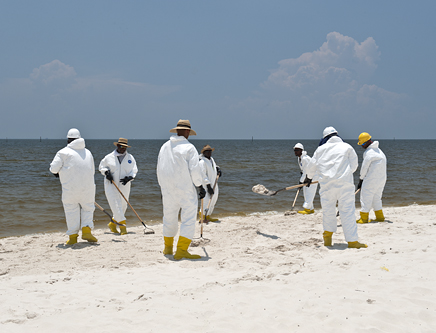
Sunday August 29th marked the 5th anniversary of Hurricane Katrina’s landfall in Louisiana. On April 20th of this year, an explosion on Deepwater Horizon – an oil drilling rig stationed near Louisiana – killed 11 crew-members, and set off the largest offshore oil spill in the history of the United States. These 2 extraordinary catastrophes have each brought into focus the more insidious everyday catastrophes that plague their respective systems.

About a week after the explosion on Deepwater Horizon, I was sitting in on the final review for Derek Hoeferlin’s urban design studio (at the Graduate School of Architecture and Urban Design | Sam Fox School of Design and Visual Arts | Washington University in St. Louis, where Derek is a faculty member and I am a student). As it came to a close, the review transitioned into a conversation between the students and reviewers, and at one point, Derek made a comment about catastrophes that struck a chord with me.

What follows is a conversation between Derek and his former student Jess Garz (WUSTL alum and current graduate student at the MIT Department of Urban Studies and Planning). Their conversation – which includes contributions by several others – struggles with the issues raised by distinct catastrophic events and ongoing systemic failures, and asks what role design and design education can play in addressing catastrophes of everyday life.

Make sure to click through to Part 2 & Part 3 of this feature, which are illustrated by student work from Washington University in St. Louis, the University of Toronto, and the Massachusetts Institute of Technology – including several examples of work created as part of the Gutter to Gulf initiative.

Aaron Plewke:  Derek, the idea for this conversation came from a comment you made at your Urban Design studio's final review in early May (about a week after the oil rig explosion that began the ongoing disaster in the Gulf of Mexico).  As a starting point, can you re-state your perspective on the everyday vs. the singular catastrophic event for the Archinect audience?

Derek Hoeferlin
July 14, 2010
Day 86 of BP Oil Spill

A week or so after the Deepwater Horizon oil explosion, most eyes, at least via the media’s gaze, were on the unfortunate lives lost from the explosion, rather than the impeding environmental disaster of what was oozing upward from deep beneath. I made a comment in a review of my Washington University in St. Louis urban design students’ work that stems from my past 5 years worth of leading architecture and urban design studios focusing on the rebuilding of the New Orleans region following Hurricanes Katrina and Rita.

↑ Click image to enlarge
image credit: © Stan Strembicki

The comment is this:

The real problems we face, not just as designers but as citizens, are not Extraordinary Catastrophes but rather Everyday Catastrophes.

↑ Click image to enlarge
Lower Ninth Ward destruction from Industrial Canal levee breach. image credit: photo by Derek Hoeferlin, Spring 2006


↑ Click image to enlarge
Upper Ninth Ward flooding from everyday heavy rains. image credit: photo by Gutter to Gulf studio, Spring 2010

Part of why I say bring this up is of self-critique. As architects, artists, designers and educators, we collectively, including myself, have fallen into a “repetitive-cause” trap that follows pretty much any crisis in the United States of America.


The real problems we face, not just as designers but as citizens, are not Extraordinary Catastrophes but rather Everyday Catastrophes.
It is a trap of responding to that of the Extra-ordinary catastrophe (i.e. Hurricane Katrina=levee failures; Deepwater Horizon oil-platform explosion=BP oil spill; exotic mortgage lending=2008 Economic collapse; 2001 terrorist attacks=Afghan/Iraq wars, etc.), rather than preventing what is right in front of our noses – that of the Every-day catastrophe (i.e. water management crises tied to poor development policies; our addiction to finite fossil fuel resources tied to the USA’s reliance on private industries for such resources; irresponsible practices of both the public and private sectors tied to Wall Street decision-making; or, national security issues tied to the USA’s complicated relationship on the global stage).

Maybe putting it more dumbly: Compare this reactive method to what has grossly lacking in our nation’s health care system – insuring preventative care.

But for some reason we have gotten into our bottom-line mindsets that prevention is economically unfeasible. There is no clear dividend on this strange form of “speculative” investment. In other words, collectively we have lost sight of design as foresight.

What is economically unfeasible is this: many of the fishermen who fetch bountiful quantities of fish we eat are out of [their original] jobs because of this gross negligence on all of our parts. According to the USDOC, Commercial fishing accounts for over $200 million of Louisiana’s annual economy, over 20% of the lower 48 states. The fish are dying; the fisherman’s wetland communities are disappearing.

↑ Click image to enlarge
image credit: © Stan Strembicki


↑ Click image to enlarge
image credit: © Stan Strembicki


But disappearing wetlands began far before the BP oil spill. According to the USGS: 1,900 square miles lost since 1930 (Louisiana has 30% of the total coastal marsh and accounts for 90% of the coastal marsh loss in the lower 48 states), 24 square miles a year between 1900-2000 (areas the size of one football field every 38 minutes), current projected land loss over next 50 years is 500 square miles; and, 217 square miles of marsh were lost to open water as a result of Hurricanes Katrina and Rita alone.  Climate change, rising seas, sinking land, single-line-defense-levees cutting off natural Mississippi River sediment discharge resulting in salt water intrusion; and, oil and natural gas pipelines cutting through the interconnected wetlands to deliver energy to a majority of the United States, have most to do with this.  According to the Louisiana Dept. of Natural Resources, Louisiana ranks 1st in crude oil and 2nd in natural gas production in the US. All of these are arguably human made, and most only made within the last century. All a Gordian knot.

↑ Click image to enlarge
Economic importance of Gulf region. image credit: Gutter to Gulf studio – Washington University students Philip Burkhardt, Erin Dorr, Jonathan Dowse, Brendan Wittstruck statistics compiled at: http://www.americaswetland.com/photos/article/web factsheet09‐14‐2009.pdf


It is estimated that 2-4 miles of healthy wetlands can reduce storm surge height by 1 foot.  Most do not know this, but healthy coral reefs reduce storm surge as well (as was the case with the 2004 SE Asia tsunami). Who knows what the status of the fragile Gulf of Mexico coral reefs are in the wake of the BP oil spill. We tend to ignore what we can’t see. Out-of-site, out-of-mind. We can see [what’s left of] the wetlands...we can’t see what’s happening to the coral reefs – reefs that are the basis for marine life.

↑ Click image to enlarge
Wetlands provide storm surge protection. image credit: Gutter to Gulf studio – Washington University students Philip Burkhardt, Erin Dorr, Jonathan Dowse, Brendan Wittstruck


To respond to our pretty-much-incompetent-measures to proactively prevent and efficiently respond to the now all-too-frequent extraordinary catastrophes, I believe that the education of the next wave of architects and designers must focus on the everyday, MOSTLY UNSEEN, catastrophes that ultimately accumulate to the extraordinary, HIGHLY SEEN, catastrophes.

Maybe this is obvious to many who will read this, but I truly believe it is being taken for granted.

We must expose the everyday catastrophes.

Jess Garz
July 28, 2010
Day 100 of BP Oil Spill

Derek, what happens when the everyday catastrophes become extra-ordinary?

The 100-year storms now seem to come every 20 years, and the amount of time between human-controlled/human-caused “storms” seems to be consistently shrinking.  I admit to be a more active world citizen this decade as compared with the last, but let’s just think for a minute of the past 10 years:

Catastrophic Natural and Human CausedDisasters
-Category 3/4 Hurricanes Katrina and Rita
-2004 Southeast Asian Tsunami
-7.6 magnitude earthquake in Pakistan
-7.9 magnitude earthquake in Sichuan province
-7.0 magnitude earthquake in Haiti
-Coal Mine Collapse in West Virginia
-BP Oil Spill
-9/11 Terrorist Attacks
-Bridge collapse in Minneapolis
-Catastrophic flooding in China and Pakistan

↑ Click image to enlarge
image credit: © Stan Strembicki


↑ Click image to enlarge
image credit: © Stan Strembicki


This is obviously just a quick (and negative) look at the past few years, but it is clear that the glory days of overbuilt and under-maintained infrastructure are over, and that as inhabitants of the earth, we will be put into check by natural systems.


...what we really have to fear are not the category 5 storms and the bridge collapses of the future; it is not the extraordinary events happening more frequently, but rather beginning to acknowledge and discuss the daily attacks on our health, sense of reason and ultimately our sanity.
But getting back to my first thought about “what happens when the everyday becomes extraordinary?” and also Derek’s reference to our (American) health-care system and its (complete) lack of insight into covering preventative care – I believe what we really have to fear are not the category 5 storms and the bridge collapses of the future; it is not the extraordinary events happening more frequently, but rather beginning to acknowledge and discuss the daily attacks on our health, sense of reason and ultimately our sanity.  The scariest thing about these attacks is that most of us don’t perceive that they are even happening. We sell each other food with no nutritional value, send our kids to schools with no educational expectations, incarcerate our offenders with no vision of reform, and fight wars, abroad and on our own streets, that claim to be fought in the pursuit of peace.

I am prone to say that in the next decade we need to take some time to catch our breathe. We are so concerned with mitigating disaster, but we no longer even know what defines disaster. It is easiest to point at the spectacular as extraordinary, but I ask that we question this tendency.  I think it’s pretty extra-ordinary that 1 in 3 American children is obese, and that our prison population tops 2 million.  An oil rig exploding in the gulf is specular and spectacularly tragic, but is it really extraordinary? We don’t smoke at gas stations because we are aware, even in our ordinary lives, that oil and gas can explode.  We are also aware that when a pipe breaks, the contents flood.  These concepts are ordinary.  
An obese, over-eating, leisurely child that is suffering from malnourishment is not ordinary. Unfortunately it is also not spectacular. But, in my perspective, it is a DISASTER, and a disaster to the highest magnitude.

I do not want this to become a debate about semantics. So Derek, do you think we should, for the sake of clarity, define (or attempt to define) the terms - disaster, extraordinary, catastrophe, spectacular, etc.?

Derek Hoeferlin
August 4, 2010
Day 106 of BP Oil Spill
“Well is Dying, BP Says” -CNN

I think Jess’ point about “taking a breathe over the next decade” is really appropriate. Taking a breathe doesn’t mean laying around on the couch and not doing anything for a while and catching up on back episodes of Law and Order. In fact it’s exactly the opposite. It’s about patient, diligent and well-informed work over a longer time-frame, a.k.a - maybe an actual definition of sustainability? I once read one’s reaction to the word “sustainability” in Dwell magazine. The person was asked how his or her’s marriage was: “my marriage is sustainable.” I don’t think that makes sustainability sound so hot.

But long-term commitment makes sustainability sound a bit more palatable.

I’m not sure we have to define what the terms disaster, extraordinary, catastrophe, spectacular, are, in a rhetorical sense per se. Rather than clearly define words that aren’t clearly definable, I think it’s more appropriate to continue the thread of how Jess and I are questioning disaster response through our own experiences since Hurricane Katrina. Our critical reflection of experiences and delivered work ultimately lead to the definition that will help us, help the future students, and maybe help some of the Archinect readers better prepare through design (resilience=sustainability), rather than react through design (recovery=rebuilding). I just think it will make architects, artists and designers a bit smarter and ahead of the curve. Jess and I have been involved in the reactive method and want to get to the preparatory method. People who will read this will wonder who the hell the two of us are and why are we talking about this stuff? Where’s the proof? We’re not recognizable like Brad Pitt. We need to explain ourselves, through actions.

So maybe a little bit of definition first. Dictionary.com defines “disaster” as a “calamitous event, especially one occurring suddenly and causing great loss of life, damage, or hardship, as a flood, airplane crash, or business failure.” “Disaster,” at first glance, is thought of as the hurricane, the earthquake, the oil platform explosion, etc...the “extraordinary” that occurs “suddenly.” Then the “ambulance chasers” swoop in for the triage response. Ambulance chasers, in our case, are architects, artists and designers reacting in a militaristic methodology, not just the typical “ambulance chaser” lawyers. I don’t know many architects or designers with military background, but I find this knee-jerk design response strange and borderline experimentation on post-disaster citizens. Case in point, without me pointing any fingers, after Hurricane Katrina some design schools’ students led by their “good-intentioned” faculty did just this after the hurricanes: quickly caravan in, build something “good” for a community without much community input of what “good” means, leave quickly without being held accountable for the fallout of whatever was “good,” get the “good” object published in a slick design magazine that only architects read; and, ultimately add the “good” work to the tenure packet. In other words, what I call “ambulance chasing.”

But, it is only once one begins to engage the perceived immediate “disaster” for longer sustained periods that the everyday disasters begin to expose themselves; i.e. - that child obesity is one of the everyday disasters embedded within the health care debate that is presented to us as the extra-ordinary disaster. To put it another way, my students and I were asked to build a new chicken coop for a community garden in New Orleans. The original coop was damaged by Katrina. That was our simple design challenge in response to the “extraordinary disaster.” Only after getting to know the mission of the garden more is when we realized what we were actually doing: through a simple catalyzing funky chicken coop we were addressing the “lack of access to healthy food disaster” that has long besieged New Orleans...and what ultimately helps lead to child obesity that leads to higher health care costs, coupled with lack of insurance, and ultimately leads to the extra-ordinary health care disaster.

↑ Click image to enlarge
NOLA Chicken Coop – design/build by undergraduate architecture students at Washington University in St. Louis, Spring 2008. Students: Alla Agafonov, Nicholas Berube, Elizabeth Bochner, Claudia Bode, Eric Cesal (Teaching Assistant), Zhan Chen, Leigh Heller, Kathleen Johnson, John Kleinschmidt, Andrew Stern, Aaron Williams. image credit: photo by Derek Hoeferlin, Spring 2008


So as architects, artists and designers we have one advantage over the jaded pundit or the crazed blogger. I don’t want this piece to turn into that. We don’t just talk about things – why disasters happen or how they shouldn’t happen, etc. – we make things or we enable things. I guess this has come to be known as “design activism,” or simply what architects, artists and designers are supposed to do.

Jess Garz
Sunday afternoon, August 22, 2010

Yesterday I visited the Philadelphia Museum of Art to view the “Late Renoir” show, though I am not a fan of his paintings – the show was curated to highlight his dedication and reverence for the everyday. To paint his children and friends in his home, combing hair or playing a song rather than staging a formal model in a regal pose.  Seems oddly relevant to this conversation.

Derek, about your last writing – think you're right. Theory and allegory are fun (and self-serving) but not always so useful.  So to start, I am pasting some opening words I wrote for the Transforma website, which was recently redesigned, reconsidered and renewed.  And for reference, for the past 3 years, I have served as the sole staff person for the Transforma initiative, which was founded by artists and arts administrators – Jessica Cusick, Sam Durant, Rick Lowe and Robert Ruello.

In the aftermath of Hurricane Katrina, we formed Transforma to expand opportunities for artists to use their creativity in the rebuilding of New Orleans. As practitioners within the field, we had seen art and culture become increasingly commercialized, limiting the opportunities for artists to work in public or socially engaged practices. To counter this trend, Transforma strategically supported such practices with direct financial assistance, technical assistance, and networking opportunities. Generally it encouraged a greater emphasis on the role of artists, the arts, and culture in addressing the social and political needs that confront our society.

Although Transforma focused on the post-Katrina landscape, we would like to acknowledge the innumerable cities and communities throughout this country with shared legacies of disaster— whether social, physical, economic, or environmental (like the current oil-related disaster in the Gulf Coast). We hope that this website, the print publication, and the past five years of work in New Orleans, will encourage engagement in, and discourse about, art, creativity, and community.

I bring these sentences to the conversation as a means of introducing Transforma, but also as a means of beginning a conversation about the adaptation of skills from an extra-ordinary context to that of the everyday.  How can the work in which Transforma participated or supported, post-Katrina, be applied to other cities, towns, communities (before a “Katrina”)? The publication that we released in July of this year (2010) intends to continue/initiate such dialogue, and more importantly inspire action elsewhere. Post-Katrina New Orleans was a place filled with a lot of energy both positive and negative. “Ambulance-chasers”, “carpet-baggers” and “self-important do-gooders” were part of that mix, but at this point I would rather stay away from the name-calling and focus on what really happened. There was a disaster in a struggling American city. This struggle was defined by decades of urban disinvestment, a legacy of political insecurity (some might call corruption) and unresolved racial and class tensions. Sound like New Orleans? Yes. But it also sounds like many other American locales. But to continue with the story... we start with a struggling city, and then one day, we have a catastrophic natural disaster, followed immediately by the catastrophic infrastructural failure. Next we have chaos/disorder that exacerbates trauma, followed by “under-effective” response from the government (implying that it is possible that the resources were allocated, but maybe not to the right people or in the right period of time). Then we have wide-spread frustration and maybe distrust in government. And then very quickly following an inspired, yet incoherent rush of independent aid. This includes the individual volunteer, the activist-architect, the activist-artist, the activist-designer, the university professor and student, the national foundation, and many others. The point that I am trying to make is that the disaster was really effective in drawing together a lot of really interesting people, and honestly a whole lot of money. In my work both with Derek (while we worked with H3 Studio) during the Unified New Orleans Plan (UNOP) and in my work with Transforma, simply put, I was compensated thanks to the support of national foundations. This was the case for a lot of folks in New Orleans, natives and non-natives alike. The point of this story is this – it is our responsibility as people/organizations/universities to hold off on patting ourselves on the back about the work in New Orleans, until we spend the time and energy considering how the lessons learned in the city Post-Katrina can we applied or shared with other locale. I argue this point because so many of the issues that we tackled Post-Katrina were actually pre-exisitng problems – problems that clearly ail other cities. I will speak very briefly about some of the Transforma-associated projects to make this point in a quick and dirty way.  (Please refer to www.transformaprojects.org for more coherent information about all of this work)

1. Home, New Orleans? (HNO?) is a community-based, arts-focused network of artists, neighbors, organizers, schools, and universities that brings together diverse constituencies in long-term collaborations to create positive change in New Orleans. One of the main concerns of this project is that resources and experiences in different New Orleans neighborhoods vary tremendously, based on racial division, economic class – prior to Katrina there was rarely collaboration between neighborhoods and very little institutional collaboration between Xavier, Tulane and Dillard universities.  This project was mildly to very successfully at accomplishing these goals. (again, pre-K issues that are faced in most cities).

2. Fundred / Paydirt: The Operation Paydirt / Fundred Dollar Bill project seeks to facilitate the complete transformation of New Orleans into a city with lead-safe soil through the delivery of a scientific solution to lead contamination while calling for action through a nationwide drawing project designed to engage young people. (This project looks to New Orleans as the savior city, since so many American cities deal with lead poisoning).

↑ Click image to enlarge
Safehouse preview party for the Fundred project. St. Roch neighborhood, New Orleans, October 2008. image credit: Transforma


↑ Click image to enlarge
Press conference for the Fundred project held at the Safehouse. St. Roch neighborhood, New Orleans, November 2008. image credit: Transforma


3. Plessy Park:  The project was initiated by community activist Reggie Lawson of the Crescent City Peace Alliance, artist Ron Bechet, and others to acknowledge the site on which Homer Plessy was arrested on June 7, 1892. There was event held on the anniversary of Plessy’s arrest in 2008 to bring together the various stakeholders – of the land and concept. This event highlighted how civil rights concerns of the 19th century relate to contemporary civil rights issues, especially related to the public education system.  (Again, an issue in New Orleans and elsewhere throughout the country).

↑ Click image to enlarge
Temporary chalk board installation for Plessy Day 2008. Corner of Press and Royal Streets, New Orleans, June 2008. image credit: Transforma

4. Creative Recovery Mini-Program: supported work produced at the intersection of art, social justice, and recovery in New Orleans.  Mini-grants provided direct project support for the work of independent artists, unincorporated groups, gathering spaces, publications, and collectives active during the rebuilding of New Orleans. In each round the applications were reviewed by a different panel made up of individuals with professional backgrounds in art history, community organizing, education, community development, urban planning, urban agriculture, real estate, and housing rights.

↑ Click image to enlarge
Convening of mini grantees from rounds 1,2 and 3, New Orleans, July 2009. image credit: Transforma


The general idea that I am getting at is the question/statement - how do we harness the energy and fervor that disasters often inspire and apply such to the everyday recovery needs of society?

Also, I’m interested in conversation about water management and how it’s not only a design, economic, and political issue, but also cultural.  [Obviously] everything is cultural, but I think “we” as designers, economists and politicians [ignorantly] undervalue such consideration. As the fifth anniversary approaches, and the specials begin appearing on Dateline NBC and every other popular news program, it is hard not to crave the extraordinary, but in thinking back on the past five years of work and participation in recovery, the actions of the everyday are more inspired and ultimately more addictive.  

Continue to Part 2