Architects for Peace news and articles

22.5.20

How Might the COVID-19 Change Architecture and Urban Design?

The following interview by Michel J. Crosbie of Prof. Ashraf Salama has been republished with the authorization of those involved and Common Edge Collaboration's director Martin Pedersen.
Prof. Ashraf Salama is a long-time contributor to Architects for Peace and its editorial committee.


In the wake of the global pandemic crisis, there’s been speculation about how architecture, urban planning, and design might be permanently affected. Ashraf M. Salama, a professor at the Department of Architecture, University of Strathclyde, in Glasgow, Scotland, and the director of the university’s Cluster for Research in Architecture and Urbanism of Cities in the Global South, has been following how these disciplines might be changing. He’s recently written a publicly peer-reviewed paper on some of his findings: “Coronavirus Questions That Will Not Go Away: Interrogating Urban and Socio-Spatial Implications of COVID-19 Measures.” I sat down with Salama to discuss some of the issues he raises, and what their implications might be for the built environment in the future.

16.10.16

October Talk @ Building 50, RMIT

Architects for peace went around the streets of Melbourne to gather thoughts on homelessness in our city.
Here is a teaser for the full length video to be shown this Friday"
Join the discussion this Friday 7th of October @ Building 50, RMIT - 7pm.
Event details: bit.ly/arch4peaceoctalk


15.3.13

Archinect Interviews George Brugmans, IABR - Part 1, Making City

This article was first published in Archinect and has been republished with the permission of its author Orhan Ayyüce, member of the editorial board of Architects for Peace.


“I do not believe in throwing good stuff away. Every IABR edition builds on earlier editions. We refocus, change perspective, pick up new elements; we re-use and reconfigure, and then we scramble and stir. Compared to most other Biennales, we’re poor and small, so we have to be smart, not waste what we have, choose our battles, break rules, find shortcuts, work with good people, make friends and truly commit ourselves.” - George Brugmans
IABR, International Architecture Biennale Rotterdam is the most engaged urban Biennale in the world. Supported by the Dutch Government, the city of Rotterdam, the municipalities where the IABR runs test sites and the collaborators from NGO's, this urban biennale continues to discuss, engage, make, critique and invent solutions for pressing problems regarding the present and the future of the cities in this so called urban century with rapidly growing megalopolises and populations.
IABR holds that when we would all be living in better-made cities our future would be more sustainable, socially as well as economically. It therefore considers Making City to be the principal imperative of our times.
This is my second interview for Archinect with the Executive Director of IABR, George Brugmans, and the conversation continues from where we left it two years ago.
by Orhan Ayyüce
PART 1 Making City

A short introduction to the 5th IABR: Making City (Courtesy of IABRfilm)

28.4.12

Footscray Community Lunch

In december I wrote about corporate social responsibility; I questioned if the reasons why individuals volunteer their time and money towards charitable causes are the same reasons corporations do similar? I looked at Footscray and how its is rapidly changing and is expected to continue to change - so to follow up, over chirstmas Kamil, Katherine and I were invited to the Footscray Community Lunch. This is part 2 of a 3 part – stay tuned for the next post.

28.9.11

Stretch and squeeze: Sustainability vs. sprawl in crowded Asian cities

Dr Sidh Sintusingha discusses the phenomenon of urban sprawl and approaches to enabling sustainability in increasingly crowded Southeast Asian urban corridors. With host Jennifer Cook.

JENNIFER COOK So in your view is urban sustainability even possible and what are the consequences if it’s not? 
SIDH SINTUSINGHA Well putting an idealistic hat on it is possible but we human beings have to be given the big stick, you know a very serious environmental catastrophe for instance might push us towards that direction. But…

Up Close, the research talk show from the University of Melbourne.

16.10.09

Meeting Mike Davis

Interview by Orhan Ayyüce

Mike Davis and I met on a summer day in San Diego. He graciously drove his truck and showed me his collection of “interesting sites” he planned for us to see in the area. As we were visiting those places, we talked about variety of subjects.

His selection of the sites, was nothing less than socio-cultural paintings in action, plus a rough sketch of complex connections, drawn by him.


He and his wife picked me up from the Greyhound bus station in downtown San Diego. We then got their twin kids from the school, after stopping at the neighborhood Starbucks, we stopped by his house, and shortly after, him and I changed to his pickup truck.

As soon as we were in the cab, I asked him if they like watching movies and he said,

“Yes, and we like foreign films too.”

I reached to my bag and gave him a copy of ‘The 10th Victim’ by Elio Petri, a 1965 Italian science fiction I brought with me.

On the freeway to first site, the conversation steadily jumped from Turkish films of Yilmaz Guney whom Davis knew, to Jazz scene in Istanbul, then to The French anarchist movement, and Avant Garde without losing a beat.
“Didn’t write a word until I was thirty years old... I am a self-taught writer. Started in UCLA as a student to study economics as a freshman.”
As the words to be said piled up, I heard the slowing thread noise from the tires and the changing gear of the transmission, an exit from the freeway and find myself looking at a panorama of a town from the higher elevation beyond the cinemascopic windshield.

Mike Davis said, “This is El Cajon,” with four words and with a space on either end.

El Cajon is a balmy and seemingly ordinary town near-east of San Diego. A small city that could easily worked into a novel. I initially associated it with Steinbeck gone south kind of space.

The place, meaning 'the drawer' attributed to the geographical shape of the location, a boxed in valley, started out as a farming town producing grapes, oranges, raisins from deeply drawn, lengthy, farm sized lot divisions and tract maps.

In the beginning late 19th century, the fertile valley was populated by 563 people, 98 percent white, including some east coast transplants, small farmers and gold prospectors, two Chinese, ten Indians, and one Japanese as written in an essay by Victor Geraci called, El Cajon, California 1900. This statistical narration is relatively descriptive of San Diego County's 35,000 strong population back then.

Later, the military personnel who work at various bases in the vicinity moved there.

El Cajon is where Mike Davis grew up in a neighborhood, made up by Irish immigrants, appropriately called “Boston Colonnade.”

During the 60’s Hell’s Angels made El Cajon one of their concentrated settlements, numerous bike shops and biker oriented business opened up and sustained to this day.

Most recently, Chaldeans arrived in El Cajon. The Chaldeans are Iraqi Christians, who survived the invasions and wars throughout the history in their native land in Middle East, until the ongoing Gulf Wars. As a direct effect of the wars and complex conflicts there, most of the community relocated on the other side of the globe as forced immigrants. For the Chaldeans, in fact, the Gulf Wars were the 'Mother of all Wars' causing mass exhodus. Many of the Chaldeans now live in Detroit, Chicago, El Cajon, San Jose, and Turlock, and in the South of the US border, Oaxaca.
“Nowadays, writing comes out fairly easy. When you are a young writer, you have the ideas, as you get older you get much more efficient with them.”
Shortly after the panoramic experience, we stop at the biker stronghold strip of El Cajon, called 'Iron Valley' by Mr. Davis. I am told, currently the Hells Angels are pressured by the "City" to earthquake proof their establishments or “leave.” A hastily passed building ordinance creating social alienation and financial hardship on some of the bike shops and subculture of Hells Angels specifically, as if the pressure is not enough on them. There is a feel of summary judgment for otherwise colorful community, I thought.

Knowing a little about Route 66 and the money biker tourism pumps into the economy, it's not good. Consider the currency left by tourists who visit the West, buy & rent Harley Davidsons to become the wild ones, on their paid vacations, touring the American West all the way to Texas Panhandle, with some bikes choppered for real ‘bad’ riders, later redeeming their business class mileage upgrades, heading back home, in many cases shipping the bikes to their countries.

You cannot write off the legitimacy of the majority bikers because of the busted methamphetamine gang.


A mile later, Davis point out the big televangelist church building to address recent mayor’s and city council’s moral preferences. It is like El Cajon wants to become a 'Heavens Angels' city.

Just as we were talking about these things in the cab, a sharp right turn in downtown area where the City activated a revitalization plan, not unlike you see everywhere else with festival banners, median planters and storefronts.

And after a left turn, we are in the parking lot of:


UNARIUS for “Universal Articulate Interdimensional Understanding of Science.”

This is El Cajon’s even more eccentric tenant.

We walk inside the Academy where there are two Unarius members, Billie McIntyre and Priscilla Morse volunteering to care for the friendly institution.

With an echoing voice Mike Davis says, "Hello Ladies," as we approach. He reminds them he was the guy who brought the French radio station people recently and they remember, “Oh yeaah,” in unison.


Here in this well established academy, past lives, creative spiritual present and heavenly futures unfold, as the ladies start to explain some of the principles of their studies.

El Cajon is outside, but inside there is a whole universe ‘not’ caught in the banal reality most of us know and experience. If you think about commitment to higher elevations and philosophical terrains, this is it with its visual aids.

In Donna Kossy’s KOOKS, it is stated members take it as an offense when referred as religion.


Decie Hook, the current manager of the URIEL Academy in El Cajon says, “We are a scientific research organization,” standing in front of an inspirational artwork on the wall.

After enrollment, Unarius students find out from the higher beings about their past lives, and than develop a constructive and alternative present and promising future lives. As they recognize their own past mistakes here on Earth and on other planets, they try to purge all that through the study of Urariun principles, which were put forward by Archangel Uriel aka, Ruth Norman Uriel (Universal Radiant Infinite Eternal Light).

Indeed, Universal Radiant Infinite Eternal Light is the guiding beacon of the site planning of the city, The Star Center, they have designed for their planned future community.

Ms. Hook explains the city via the eight foot diameter model as we listen carefully.


The Star Center developed around the central energy beamed from a Tesla tower and radiating sections, neatly and architecturally articulated with glitter and automated walkways connecting the residential areas sliced between the leisure and agricultural fields. The way Ms. Hook explains the Star Center, everything has that robotic technology and ease we see in the futuristic films and science fictional speculations.

The clusters of neighborhoods around the smaller energy towers replicate the bigger pattern. Macro to micro, a well visited concept in recent urban design circles, brought to Star City of Unarius by the more intelligent visitors in 'us' and ‘over there’ all the same...

I notice the wall surrounding the ideal city and ask, “why, to defend the place?”

Ms. Hook explains, “the walls are there because there is no life outside of them...”

I decide not to go any further.


The conversation with the “ladies” continues into the material found in the Academy's website. I turn off the tape recorder and start to walk around like I am in a museum and take pictures of some paintings done by the students. At one point Mike Davis turns to me and says, “Everything in here is American folk art.”

My curiosity with the place is etched around the Utopian city of Unarious, the Star Center. The capitol in which all the past lives fixed to perfection and justice and equality for all.

If anything, this is even more complete as utopian cities go, than many I've been seeing in design blogs, providing the spiritual guidelines as well as the political and social infrastructure on top of the highly configured physical environment with jewel like attention to detail and the scientific co-operation and know how of their interplanetary higher intelligence brothers and sisters.

If we are going to be open to the futuristic illustrations of post apocalyptic societies ahead of us, why not them, why not the UNARIUS?

I feel Mr. Davis’ fascination with the place and kind of understand it.

He buys two of their books, I pick up all the free brochures. We say our goodbyes to the ladies and walk out.


Outside on the sidewalks of El Cajon is a different world. The folk art is there, but just a different reality.

A couple of heroin junkies with fallen teeth pass by us as we are walking on Main Street sidewalk and I ask Mike Davis,

“have you been in jail?”

He says he has for minor stuff and a thrown out felony for civil rights and resistance related issues...

Better and classier than my own past of unpaid traffic tickets turned arrest warrants and barfly incidents ending in jails, overnight and longer. We briefly talk about county jails and this conversation terminates as we pass by another couple sitting in front of abandoned shop with a Colt45 halfway sticking out from the brown bag.


Passing by the well stocked Iraqi grocery stores, the Chaldian Community seems to be doing better and money is trickled down to El Cajon by a distant war in Iraq. Some are hired by US Government as translators and perhaps with the promise of speedy US Citizenship. I observe this through the passport and a plane ticket inspired recruitment brochure of National Guard at the reception area of the Ali Baba’s Restaurant where we sit down in the all mirror area to have lunch.


Mr. Davis orders the special stew made of innards of lamb including head meat and other delicacies whereas I order the simpler ground beef kebab, perhaps one of the most delicious one I have had west of Turkey.

I ask if he cooks. Having come from a butchers union background in his youth, he says, “Sure.”

He is the cook in the house and they are usually cholesterol heavy meals, which him and his family trying to cut down a little.

I describe him a Turkish soup recipe after observing his stew. In return gesture, he gives me his recipe of Egyptian 'fatta' he learned how to cook from his Egyptian roommate when he lived in Europe.

Lunch conversation slides into one of the important highlights of his life when he met Vietcong people in Paris circa 1973.

Mike Davis has actively started working against Vietnam War since 1964.

I ask,

“how did you start writing?”

“Didn’t write a word until I was thirty years old... I am a self-taught writer. Started in UCLA as a student to study economics as a freshman. It is a most painful way of becoming a writer, I was one of those people who would go through whole stack of paper for the first paragraph” he adds, “nowadays, writing comes out fairly easy. When you are a young writer, you have the ideas, as you get older you get much more efficient with them.”

He continues, “I recently taught creative writing in UC Irvine... For me, learning to write creatively was so brutal. I wouldn’t recommend that to anybody. Some of the students have this fantastic talent but they are so absorbed writing about themselves. A lot of them didn’t have a lot of experience in life. And, I am socially conservative and can’t really stand this mode of people exposing themselves so much... Particularly this premature self exposure about yourself and your family and all... Internet is full of that.”
“I am socially conservative and can’t really stand this mode of people exposing themselves so much... Particularly this premature self exposure about yourself and your family and all... Internet is full of that.”
I add, “I notice that as well. A lot of people are excessively self-absorbed for some reason. I mean, art can be autobiographical and all, but... Self expression is really saturated and overrated. Everything becomes me and myself.”

We talk a little about if that has to do with self gratifying life styles, the social status of the parents, the homogeneity of education.

Eventually the conversation evolves into the issue of scarce availability of architectural education to poorer communities and social disconnect of the architectural profession.

Mike Davis says, “I had a student once in Los Angeles, her project was a crematorium for the homeless people on the banks of LA River. I have never seen a proposal morally so screwed… It is funny, I get invited to a lot of schools to talk about architecture.

Michael Rotondi invited me to teach architecture in Sci Arc and I told him that I don’t have a clue about how to teach architecture. He said, that’s fine. We have a lot of people know about architecture but not enough people know about Los Angeles. You teach about Los Angeles.”

I tell him that I have, among few others, read his; City of Quartz, Let Malibu Burn, Ecology of Fear, Vigilante Man, Learning from Tijuana, and the City of Slums. And I am not really fascinated with the 'slums' subject in the same way many in the media and academia are these days. I tell him also, many in the developed Western countries are fascinated by it because they have never seen anything like it in their highly regulated environs. They are fascinated by how it looks physically and organically. Growing up, I had been to and stayed in many places what we call Gecekondu in Turkey, omnipresent in the fringes of almost every city.

I ask him, “What do you think of the current interest in slum communities. It is almost unfortunately 'redeeming' to talk about slums and their informality? The architecture is high on slums, minus the critical process and minus the perception of poverty and political injustice...”

He answers after a secondary pause,
“I had a student once in Los Angeles, her project was a crematorium for the homeless people on the banks of LA River. I have never seen a proposal morally so screwed…”
“You know, in architecture school most people talk about icons and counter icons, rather than try to understand the larger social networks, hierarchies, and conditions that produce particular types of urbanisms. That is taken to its highest level of trendiness by Rem Koolhaas. His stuff on Lagos is crazy... In my mind it is a sleazy apology for social evil.
Sure, if you want to see human self organization at work, go to Lagos, but face the poverty and oppression by the military regime, destruction of formerly proud communities... Maybe he should talk to my friend Chris Abani about that stuff... Chris would laugh at his hyperbolic formal exercise...”

“How about an extreme perhaps opposite situation; Dubai?” I ask.

“Dubai maintains legally administrative super structure. That is the Monarchy’s business model. They adopted the rules of London Stock Exchange. They have all these mini structures from there on; internet city, sex industry, tourism, free trade zone and so on. Singapore meets Las Vegas,” he answers.

I add, “Dubai is one large real estate corporation. “The future” is only a condo or a mistress away… And, Dubai has a lot of enemies these days.”

He completes my words,

“Mmm… And, they can buy out anybody…”

“What would make a successful urban design?” I ask,

As an answer Mr. Davis goes on to explain his urban design studio he taught in Sci Arc in 90's;

“We took three blocks west of Harbor Freeway around Beaudry Street in Los Angeles just west of downtown. First we broke down the community to its atoms and after that we start to develop reality based solutions. If we were dealing with graffiti, we explain to community that we will designate an area where graffiti people do their art and so on.

We developed community gardens, set up swap meets, create some economic sustainability. Our solutions are based on reality rather than an abstract building form that solves all the problems of the community only on paper.

I was influenced by the Whole Earth Catalog…

We were like architects as film makers piecing the community and putting it together. Overall idea was to also create a web site so all the communities could share the information, prototypes and other research. Of course this was right around the time internet was being born. Neighborhood building community architecture…”

Four random pages from Whole Earth Catalog

In the mean time Davis draws few examples of community building, owner occupied housing alternatives in high density areas traditionally belonging to the absentee landlords. He lays out simple and sensible plans for community incentive building via the increased amortization and eventually turning community assets to yet more community owned housing.

One of the biggest obstacles to all these interesting programs is the parking requirements, which sabotages a lot of them.

Then, we discuss use of parking limitations and how parking is monopolized throughout Los Angeles and how that impacts the development of public transportation systems. Mike Davis says, “three or four companies own most of the parking businesses in the city. And if you think where you park your car after paying a uniformed attendant has very little relevance in the development of the sensible public transportation systems, fair housing and other mass beneficial programs, think again. A good working public transportation system would put those people out of business. And they are powerful.”

He continues, “we are talking about public transportation projects and how the decisions made in this area are based on real estate development values and related profit making schemes. At this point you can imagine how around each station the real estate values sky rocket and further complications of developers and politicians are heated mostly leaving the public out of public transportation systems. While designers and architects show their wares on the drafted plans, another more sinister scheme starts to shape around maximum profiteering,” he concludes.

I ask,

“Not to change the subject but, are you pretty much a self educated teacher as well?”
“You know, in architecture school most people talk about icons and counter icons, rather than try to understand the larger social networks, hierarchies, and conditions that produce particular types of urbanisms. That is taken to its highest level of trendiness by Rem Koolhaas. His stuff on Lagos is crazy... In my mind it is a sleazy apology for social evil.”

“Yeah. They always ask me to teach something. They asked me to go back to Sci Arc to teach but couldn't give me enough money to give up my tenured position at UC... It is not like the seventies anymore that I could teach for little money. I have a family to support. Long ago I wanted to get research money to do union history research for my father's union. Being a member of the communist party made it really tough for me. Back then I was driving trucks and doing furniture deliveries. That was great because I got to see all different parts of the city of Los Angeles. I was gravitated toward teaching jobs. I even taught at Cal Arts a photography class, and I can't even operate a camera. When I was teaching in architecture school, I wanted to take the students to real places of problems and conflicts. And really study the urban problems here.”

I say,

“I proposed a class taking students to dump sites and camping there and design projects from waste. At least let them see what happens to the waste when they remodel someone's kitchen. The administrators looked at me like I was proposing a disease. I really don't care about schools sending kids to Paris and Rome over and over. Why not send those kids to East La, South Central etc.”

“Michael Rotondi is right, 'teach' Los Angeles...”

We leave the restaurant on that note and head toward Logan Heights.


A beautiful, multi function urban space, Chicano Park in Logan Heights, exists proudly under a busy freeway, snake dancing with it for resistance and capture. This is a 'place.' Unlike countless urban spaces, Chicano Park has a message.

A Brief History of Take Over is a textbook example of a community’s rising against the outside forces and reclaiming what was theirs. A barrio’s courage and ultimate glory in every way. A multi use of green space and open urban museum in every sense with high quality murals painted over real subtext.

This is clearly a Chicano achievement gained after the community's struggle with developers and powerful institutions. Examples like that we need more of, in the development of our urban lives and participation of shaping what's in our power as city dwellers and cultural beneficiaries. Otherwise you are in the hands of so called philanthropists and their politicians.

We tour the park briefly and I ask Mike to stand in front of a mural so I can take his picture. And conversation is around the highlights of the park, its beautiful murals and in fact it now exists.


I think Chicano Park should be required knowledge for all the communities that resists and struggle against gentrification and take over. A lesson on recapturing a rather undesired under freeway land and turning it into a priceless cultural treasure.

We turn around few blocks, go through a multi family residential area and arrive at;

A bit of San Diego's past signifier, an urban myth called 'Villa Montezuma Mansion.'

The story of Villa Montezuma Mansion, signifies San Diego’s notorious white nouveau riche past. The Villa was built in 1887 for a musician from London, Jesse Shepherd. Already holding stature among San Diego's ruling class, Shepherd gave classical music concerts after calling the spirits of famous composers and performing their music in front of the elite and bedazzled audience helping to sell the real estate of the developers who invited him there in the first place and built the house for him.
“They asked me to go back to Sci Arc to teach but couldn't give me enough money to give up my tenured position at UC... It is not like the seventies anymore that I could teach for little money.”
A spokesman for the the venture, Shepherd lasted two years and returned to Europe to kick start his literary career under the pen name Francis Grierson and died in 1927 'in want.' He and all the subsequent owners of the house suffered from bizarre bankruptcies and financial ruins.

A house of 'tough luck' if you will, standing on the corner with its ornate and meticulous detailing for all urban myth enthusiasts to see. I think of Jesse Shepherd, the 19th century real estate sales campaign spokesman, who gathered the Euro envy, wanna be high society prospect men listening to his tune, entertaining and culture training them with the ghost artists like Amadeus Mozart. Inside the house, the conversations to purchase and flip were abundant, while bearded men holding fine whiskey glasses, and exaggeratedly, smoking opium and snorting coke with beautiful women. We can assume 'noir' was involved.

In fact noir was always there in San Diego's closets with a lot of bones. There are stories of the city being a stage for some despicable events by the ruling class and their lynch-men. Story of the tarring and feathering of Ben Reitman, the partner of Emma Goldman, the anarchist, is a good example of one of those bones. The cover of Mother Earth says in June 1912, San Diego Edition - Patriotism in Action.


We get into his truck again and head toward his house to get some rest and talk more.

In the house we talk about Los Angeles and its hydrological issues which I want to write separately.

Days like this leave you with a lot to think about after talking about different things with one of the great writers on ecology of all sorts.

In retrospective, I have met an everyday Mike Davis, the writer, artist, a family member. I gathered he is working with all kinds of ideas, essays, books and instead of asking, I decided it is best to wait for and read them as they come out. I saw Mike Davis' engagement with the surrounding environments where he lives, grew up and carrying its memories.

We are not talking about an urban thinker who is distanced himself from his community, but a writer who knows the intricacies of all the richness in it. A connoisseur of information and research, who then compiles beautiful stories from them, gluing his audiences to his narratives, interpretations and critiques as well as laying out the nature of things so many people gloss over.


While waiting for the Greyhound bus, I quickly write down these fresh notes establishing an early triptych.

We went to see a futuristic city inside El Cajon, trumping and summarizing thousands of its predecessors, a top level contender on all utopian schemes all the way to daily details of life and being nice to yours and others' soul.

A community park under freeway, summing up urban politics of becoming a Place and becoming an inspiration.

A house built during the first real estate rush of San Diego's past for its 'ad' spokesman, who later died in want. Perhaps the classical 'seance' musicians were pissed at the financial greed of rapid speculation. This ghostly House is a closet.

I realize a reversed map of the Future, the Now, the Past were mixed.


OA, Los Angeles, September/2009

Many thanks to Mike Davis for his kindness and hospitality.


Note: this interview was originally published in Archinect (12 October 2009) and it has been re-published by Architects for Peace with the kind permission of its author.


8.2.09

We need to challenge dominant mindsets: Interview with Beatriz Maturana

Interview by Dick Urban Vestbro, 'Architects Designers Planners for Social Responsibility' (Arc.Peace) and published in ARC-PEACE Newsletter No 25 January 2009 page 2-3. Interview published with Arc.Peace's consent.

“We need to challenge dominant mindsets”

Architects for Peace Australia (short: arch-peace) is a humanitarian, not for profit professional organisation for architects, urban designers, engineers, planners, landscape architects and environmentalists, seeking urban development based on social justice, solidarity, respect and peace. It is based in Australia, but has a network of members all around the world. Arch-peace is the second biggest member of ARC●PEACE. It runs a comprehensive and interactive website (http://www.architectsforpeace.org).

31.8.08

Congratulations Sonya! : Winner of the Tenth Annual Berkeley Prize Essay Competition

Sonya Redman, member of Architects for Peace, has received the First Place for the 2008 BERKELEY PRIZE Essay Competition.

Congratulations Sonya, this is an inspiration to us all!


The following was published in the Berkeley Award website.

Winning Essays:

(May 27, 2008) The University of California, Berkeley - Winners of the Tenth Annual Berkeley Prize Essay Competition are announced today by Professor Raymond Lifchez, Chair of the Berkeley Undergraduate Prize for Architectural Design Excellence.

photo source: The Berkeley Prize website

Sonya Redman, University of New South Wales, Australia; "Shaping identity and ‘place’ in Australian Indigenous housing."

"The history of Australian Indigenous housing is a history that has real relevance in Australian government policy. In the two hundred years since colonisation, colonial, state and Commonwealth governments have taken a series of initiatives to impose social behaviour and cultural expression on Australian Indigenous people which bore no relation to their own social organisation or aspiration. Not until 1967 were Indigenous people..." Read Essay

I am in my final year of architecture and law at the University of New South Wales, Sydney. The juncture of architecture and law is an exciting one. It is a space that has the capacity to facilitate social justice, empowerment and self-determinism through the interaction of the built environment and social policy. I have a strong interest in social justice and have engaged this idea through community work, research papers and volunteer projects in Sydney, Sri Lanka and India. My final year project is centred on how architecture can serve and respond to the needs of women, especially from minority groups, by exploring and designing spatial, legal and social relationships that may impact upon them in housing and urban planning.I have learnt that there is an overwhelming need for housing and public space design to be always mindful of sustainably incorporating community needs, and in particular, to ease the adversity faced by some members of our community. After university I hope to work towards creating more equitable communities in Australia and abroad."
Under the title of Architecture is a social art, this year's undergraduate award was dedicated to the Aga Khan Award for Architecture,
"...the world’s most prestigious architectural awards program, the international Aga Khan Award for Architecture. Established to identify and encourage building concepts that successfully address the needs and aspirations of societies in which Muslims have a significant presence, the awards program has helped reveal an architecture of humanism that transcends religion, race, or nationality."
Find more about The Berkeley Prize: here


4.4.08

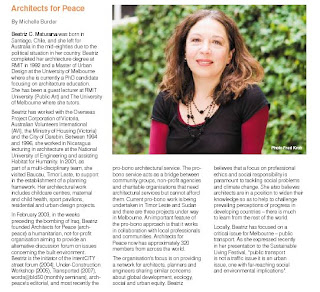
Melbourne University's Magazine: Beatriz and Architects for Peace

The following is an article published in Melbourne University Magazine for Alumni about Beatriz Maturana and her work for Architects for Peace, April 2008, p.13.
For a link to the magazine (pdf) click here

14.6.07

Lucinda Hartley: highly commended in Young professional of the Year Award 2007

Lucinda Hartley, has as a 25 year old, been active as a new generation of designers seekingmodels for change. She believes that landscape architects have a leading role to play in developing innovative solutions that are socially responsible and environmentally sustainable.
She has been an active participant in "Architects for Peace" and in "Habitat for Humanity" as a volunteer in Thailand projects.


For more information visit http://www.aila.org.au/news/ and http://www.professionsaustralia.com.au/

Find more about Lucinda's work at arch-peace pro bono: http://archpeaceprobono.wordpress.com/2006/05/13/habitat-for-humanity-build-april-2006/

7.4.07

arch-peace member takes PIA to London

London Planning People

Richard Lemon talks to Javiera Maturana, the chairperson of the newly formed UK Branch of the Planning Institute of Australia

With the ever growing number of Australian planners working in London, it comes as no surprise that the Planning Institute of Australia (PIA), the equivalent of the RTPI in Australia, has launched a UK Branch. Javiera Maturana, a planner at consultancy Scott Brownrigg, is one of the leading figures in the new branch.

Born in Chile, Maturana moved to Australia aged five, and was inspired by her parents to pursue a career in planning: her mother is an urban designer and architect and her father a public artist. A planning course at the Royal Melbourne Institute of Technology followed, and by 2004 she had worked as a planner for both the City of Yarra and the Shire of Mitchell. Her move to the UK came in 2004 when she took up a position as a retail planner with Savills in Manchester, before a move south to join Scott Brownrigg in London.
Javiera Maturana, chair of the UK Branch
of the Planning Institute of Australia
‘There are over 250 PIA members working
outside Australia, and over 50 of these are in the UK,’ Maturana says. Australian planners are helping to address the shortage of planners in London, and can take home valuable experience when they return to Australia. But there are particular issues facing Australian planners in the UK, so it made sense to set up a UK Branch.’

PIA UK was launched in June 2006 at a reception at Australia House, with presentations from both Sue Holliday, the President of PIA, and Rynd Smith, the RTPI’s Head of Policy and Practice. Since then it has been working to support its members. ‘PIA UK provides Australian planners with information which is particularly relevant to them,’ Maturana says. ‘For instance, we held an event with [advisers to highly skilled migrants] 1st Contact in late 2006, providing guidance on issues like sponsored visas. PIA UK is also a way for Australian planners to share their experiences of working in planning in Britain, and an opportunity for them to network and socialise.’

There’s no doubt that making the transition from the Australian planning system to planning in the UK is far from easy. ‘We have a zoning system in Australia,’ Maturana explains. ‘And it can be difficult to get out of this mindset. But working in a plan-led system has quite a few benefits. It improves [Australian planners’] understanding of planning in its widest sense. Particularly for young planners starting their careers in development control, planning can get too technical and procedural, and working in different systems can challenge our ideas about development.’

Despite being busy with her work at Scott Brownrigg and leading PIA UK, Maturana still finds time to act as membership secretary for Architects for Peace. ‘Architects for Peace is a forum for architects, urban designers, and other built environment professionals,’ she says. ‘It seeks urban development based on social justice, solidarity, respect and peace, and provides pro-bono services to try to achieve this. Most of its work is in the Asia-Pacific, but membership secretary is a role I can perform from the UK.’ She also worked as part of the design team for Architecture for Humanity UK’s ‘Crisis Open Christmas’ project, which provided accommodation and services for homeless people over the Christmas week.

Under Maturana’s leadership PIA UK looks set to go from strength to strength. ‘We want to provide a forum for sharing our professional experiences and provide practical support on issues such as visas and membership to the RTPI, whilst ensuring that Australian planners keep abreast of planning issues in Australia through their continued membership,’ says Maturana. ‘We’re also looking forward to discussing opportunities for joint working with RTPI London.’

CAREER DETAILS
Age: 24
Education: BASc (Planning), Royal Melbourne Institute of Technology; currently studying RTPI conversion course at Leeds Metropolitan University
Career: 2002-03, City of Yarra; 2003-04, Shire of Mitchell; 2004-05, Savills; 2005- present, Scott Brownrigg
Other roles: Member, Architecture for Humanity; Membership Secretary, Architects for Peace
Interests: Travelling throughout Europe; Latin dancing; sewing

This article first appeared in the March 2007 edition of RTPI London’s journal ‘London Calling’ and is reproduced with permission. For more information on RTPI London visit
www.rtpi.org.uk/rtpi_london

31.10.06

arch-peace: interview by GreenLeft Weekly

Architects challenge greed and war

GREENLEFT.org.au Leyal Aksu, October 18, 2006

Leyal Aksu, Melbourne14 October 2006Architects for Peace, Australia, took an active part in the protests against Israel’s attacks on Lebanon and Palestine. Beatriz Maturana, a founder of the group, told Green Left Weekly that the group formed in February 2003, in response to the invasion of Iraq. It continues to campaign against the US-led occupation of Iraq.

“It doesn’t make sense for urban professionals to build cities only to have wars destroy them”, Maturana said. When her stream of letters to MPs against the Iraq war were ignored, she decided something more needed to be done. “As professionals, we can add to the community outrage, and we are taken seriously speaking out against social injustice and environmental destruction.”

Architects for Peace is a global organisation. It describes itself as “a forum for architects, urban designers, engineers, planners, landscape architects and environmentalists seeking urban development based on social justice, solidarity, respect and peace”. It involves social and urban planners, engineers, environmentalists and artists, something that Maturana said helps break down barriers between the disciplines so there can be greater “questioning and challenging of the philosophy of greed and individualism”.

Maturana said the group draws links between the Australian government’s refusal to sign the Kyoto protocol and unsustainable urban development agendas such as privatising public space and government and corporate resistance to improving inadequate public transport systems. “The industrially advanced nations’ constant exploitation of other nations’ natural and human resources means that, unless we reverse these inequities, the resulting poverty and resentment will lead to war”, she said.

Regarding the peace movement today, Maturana believes that inclusiveness is key. “We should focus on what we have in common and strive to bring a diverse range of people together by respecting differences. The Lebanese and Palestinians need our support, and that is what we need to do right now. We should come up with immediate common demands and discuss longer-term solutions later.”

Maturana added, “It is bizarre that peace can be considered controversial, even seditious, while war is accepted as natural — at least by the government and the opposition”.

Members of Architects for Peace are also involved in pro bono work that aims to link community groups, non-profit agencies and charitable organisations that need architectural services but cannot afford to pay. “This also helps promote a discussion about architecture and planning, and its impact on people, their health and their cities. We hope that these services can promote education and participation, and assist in finding solutions to preserve our environment.”


Architects for Peace has been involved in converting a Collingwood car park into a community art facility, and the design of a library and workshop for a poor neighbourhood in Nicaragua. It is currently helping extend a community facility in Baucau, East Timor.

[Beatriz Maturana teaches architecture and urban design at RMIT and Melbourne University. For more information about Architects for Peace, visit: http://www.architectsforpeace.org/]

From: Comment & Analysis, Green Left Weekly issue #687 18 October 2006.